

Instagram reach is down almost everywhere. Reels reach fell 35% year over year, and overall post reach dropped 31%. That’s not from a frustrated marketer on a forum. It comes from Metricool’s 2026 Social Media Study, which analysed 1,059,949 real accounts and nearly 40 million posts. So if your reach chart looks like a ski slope, you’re looking at the platform-wide average, not a personal failure.
This article walks through what the major datasets show, why Instagram reach is falling, and what the accounts still growing are doing differently. Bring it to your next reporting meeting.
The evidence: every major dataset shows Instagram reach falling
One study can be an outlier. Four studies pointing the same direction is a pattern.
Start with reach. Metricool’s numbers above are the headline, and Socialinsider’s reach study tells the same story from a different panel: Instagram’s average reach rate sits at 3.50%, down 12% year over year. Back in 2020, reaching 10% or more of your followers was normal. Today most brands would celebrate a third of that.
Engagement confirms it. Buffer’s 2026 analysis of more than 52 million posts found Instagram’s median engagement rate fell from roughly 7.3% in 2024 to 5.4% in 2025. That’s a 26% decline, steep enough to knock Instagram from first to third place among major platforms, behind LinkedIn and Facebook. Socialinsider’s data, drawn from 35 million posts, puts the year-over-year drop at 24%, with brand accounts averaging 0.48% engagement in Q1 2026 when measured against followers.
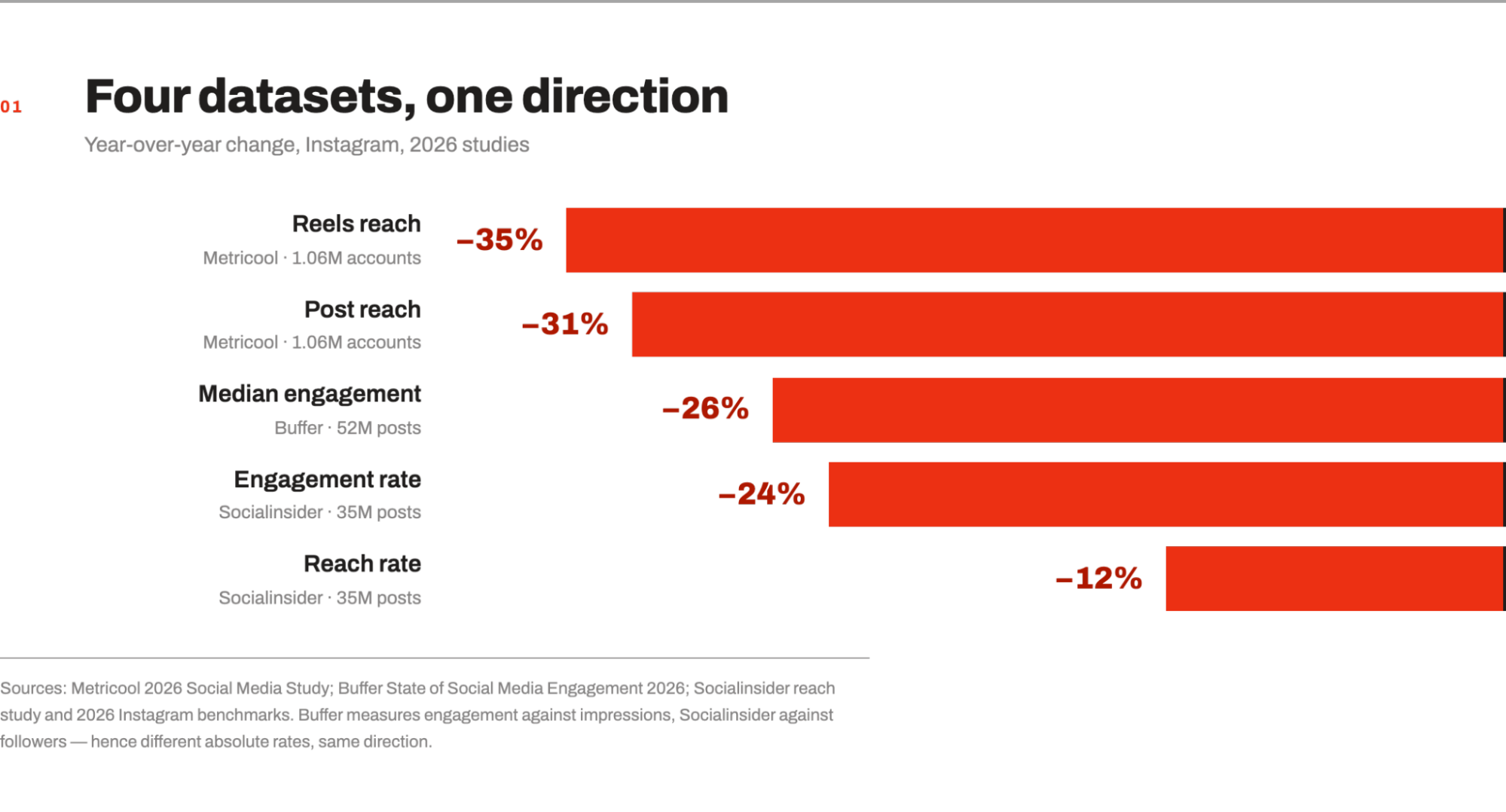
Quick methodology note, because it matters: Buffer measures engagement against impressions, Socialinsider against followers. That’s why the absolute numbers look wildly different while the direction is identical. If you compare your own rate to a benchmark, check which formula the benchmark uses first.
Four independent panels, four different methodologies, one direction. Metricool’s million-account study, Buffer’s 52 million posts, Socialinsider’s 35 million posts, and Dash Social’s 2026 benchmarks all describe the same reset. If you track your own accounts in an analytics tool, your 2025-to-2026 trend line almost certainly rhymes with theirs.
Now the part that ruins the tidy “Instagram is dying” narrative. Instagram crossed 3 billion monthly active users in September 2025, and people spend over 30 minutes a day on the platform on average, rising past 50 minutes for 18 to 24 year olds. The audience didn’t leave. It’s bigger and more attentive than ever.
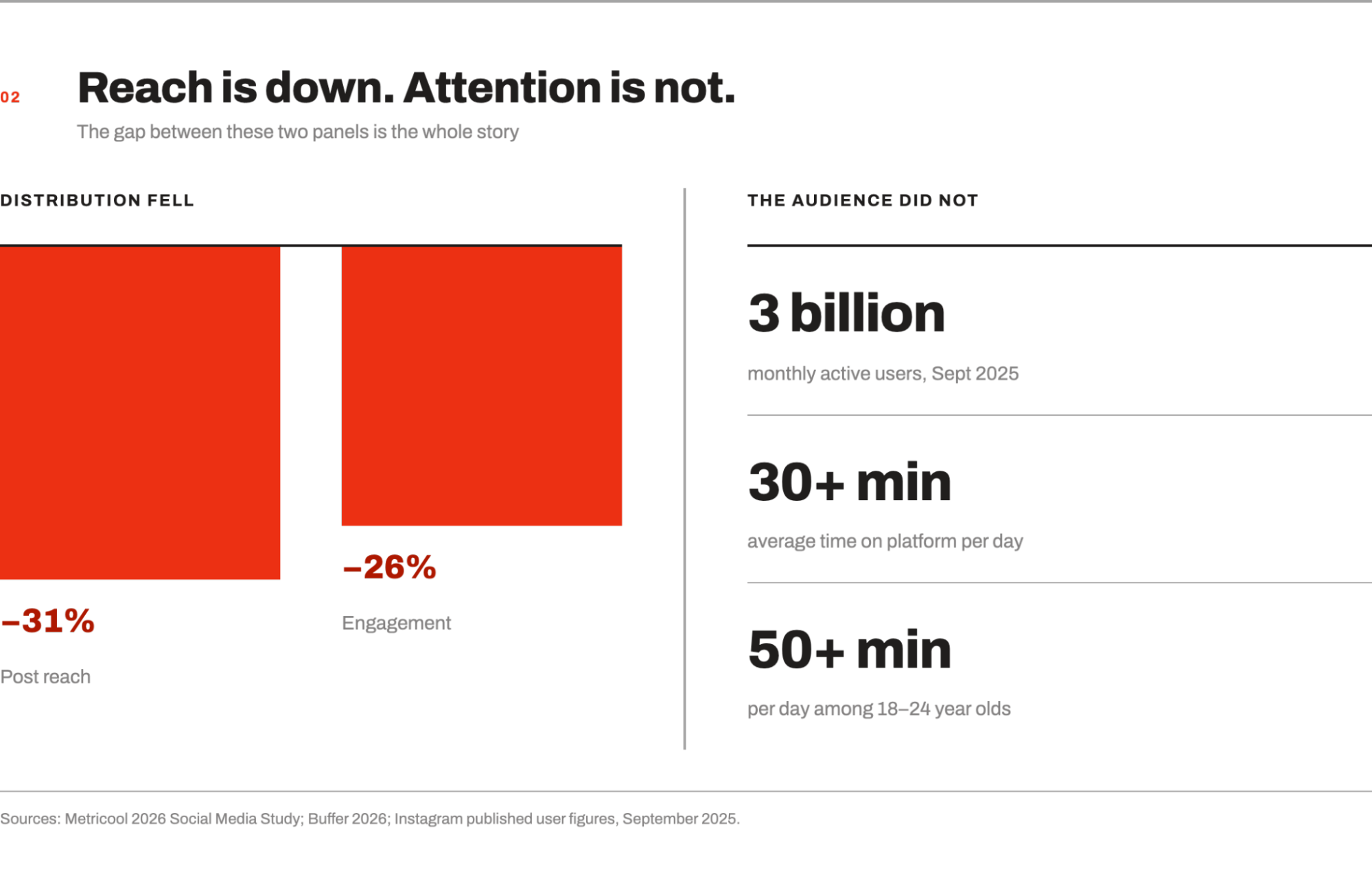
Sit with that tension for a second, because it’s the whole story. Demand for content is fine. Distribution changed.
Why Instagram reach is down: three structural forces, not a penalty
Is Instagram shadowbanning you?
Almost certainly not. The shadowban theory survives because it’s emotionally satisfying. A hidden penalty means someone did this to you, and penalties can be appealed. The real mechanics are less dramatic and more useful to understand, and there’s a two-minute test at the end of this article that will tell you whether you’re actually restricted or simply competing.
Force 1: saturation
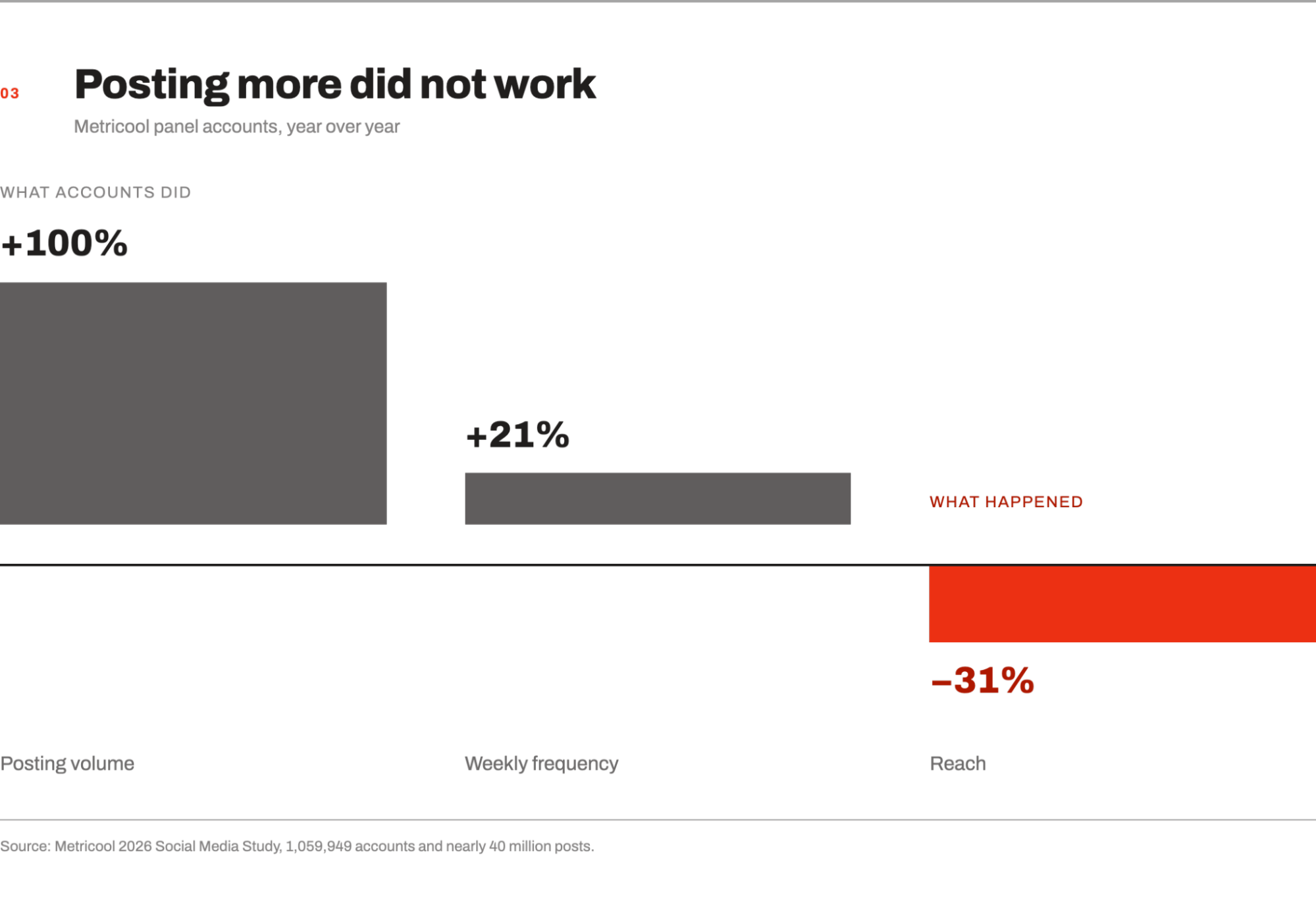
Metricool’s most telling finding isn’t the reach decline itself. It’s what happened alongside it: accounts in their panel doubled their posting volume and increased weekly posting frequency by 21%, and reach fell anyway. More content competing for the same 30 minutes of daily attention means a smaller slice per post. That’s arithmetic, not conspiracy.
AI is pouring fuel on this. Metricool’s 2025 State of AI study found 96% of social media professionals now use AI somewhere in their workflow. Some use it to sharpen genuinely original ideas. Plenty use it to publish more adequate, forgettable content faster. Audiences respond the only way they can: by scrolling faster.
Force 2: the algorithm pays out on different signals now
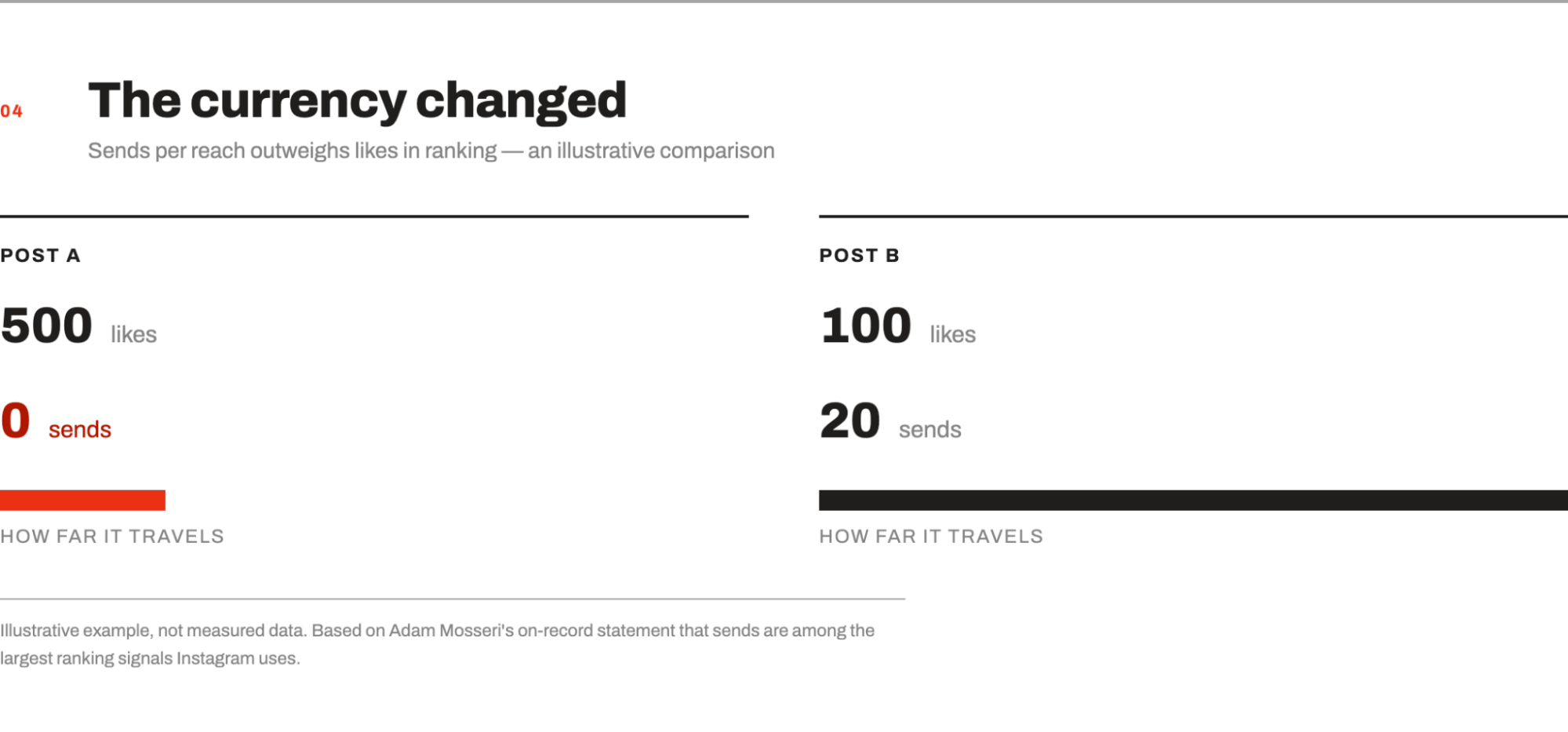
Adam Mosseri has been unusually transparent about this. The signals that matter most in ranking are watch time, likes per reach, and sends per reach, meaning how often people share your post in a DM relative to how many saw it. His advice to creators was blunt: think about making something people would want to send to a friend, because “sends are one of the biggest signals we use in ranking.”
Here’s why that stings for brands. The engagement most social teams optimise for, and report on, is likes and comments. That’s precisely the behaviour that’s fading. People increasingly watch, save, and forward content privately without ever touching the like button. Mosseri himself has noted that teens now spend more time in DMs than in Stories, and more time in Stories than in the feed. The interaction didn’t die. It moved somewhere your dashboard wasn’t looking.
A post with 500 likes and no sends can travel less than a post with 100 likes and 20 sends. If that sentence surprises you, your reporting is measuring the wrong currency.
Force 3: original content got a structural boost, and everyone else got cut
Instagram has spent two years tightening the screws on reposted content. The originality rules first applied to Reels, and in April 2026 Instagram extended them to photos and carousels: accounts that primarily post content they didn’t create, or haven’t meaningfully transformed, are no longer eligible for recommendations at all. No Explore, no suggested posts, no reach beyond existing followers. Watermarked TikTok re-uploads, screenshots of other people’s posts, and credit-in-caption reposts don’t clear the bar. Instagram says roughly 75% of US recommendations now go to what it classifies as original content.
Industry reporting suggests aggregator-style accounts saw reach collapse by more than half after enforcement, while original creators gained substantially. Treat those exact percentages with caution (they come from secondary analyses, not Instagram), but the direction is confirmed by the policy itself. If your brand’s content mix leans on repurposed clips and borrowed memes, this force alone could explain most of your decline.
Which force matters most? For a typical brand account, I’d argue Force 2, and it’s not close. Saturation is real but you can’t un-saturate a platform, and the originality rules only bite if you were reposting heavily. The signal shift is the one thing you can act on this quarter, because it’s a change in what you make and what you measure, not a change in how much you spend.
Whose Instagram reach is hit hardest, and whose isn’t
Averages hide as much as they reveal, so before you apply a 31% haircut to your forecasts, look at the distribution.
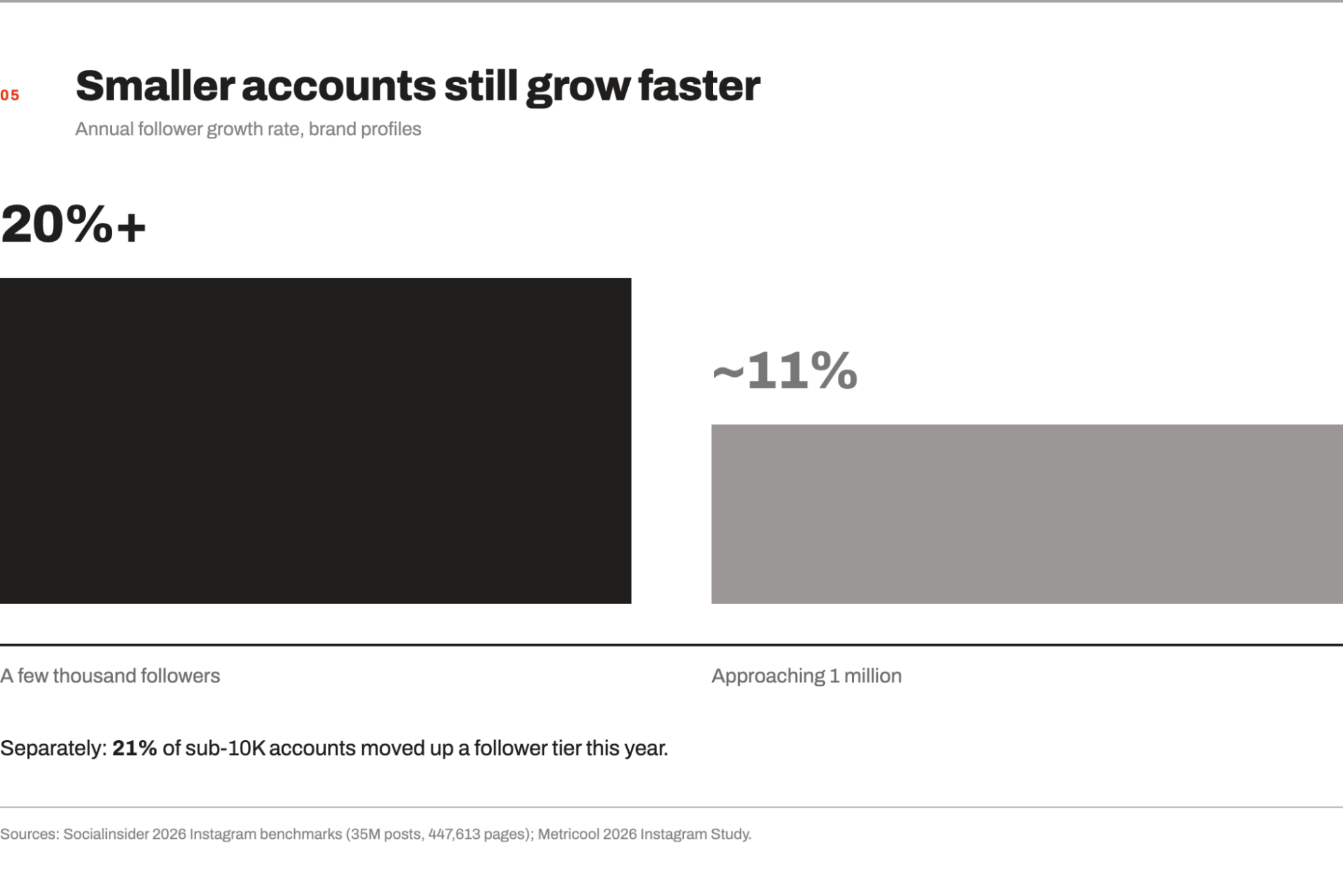
Account size matters. Smaller accounts consistently punch above their weight. Buffer’s benchmark data shows engagement rates decline naturally as accounts grow, and Metricool’s 2026 Instagram Study found smaller accounts still have real room to grow, with 21% of sub-10K accounts moving up a follower tier this year. The algorithm increasingly rewards engagement quality over follower count, which is quietly good news for challenger brands and bad news for accounts coasting on a big but sleepy audience.
Format matters, but not the way most strategies assume. Reels remain the discovery engine: Metricool found they generate over four times the interactions of single-image posts, with average watch time more than doubling year over year to 8.5 seconds. But Buffer’s data shows carousels earn meaningfully more engagement per person reached than Reels, and Metricool found carousels earn nine times more saves than single images. The translation is simple. Reels reach strangers, carousels convince them. An account posting only Reels is optimising for introductions and fumbling every second conversation. Single images, for what it’s worth, are the format actually dying: Metricool measured their engagement down 46% year over year.
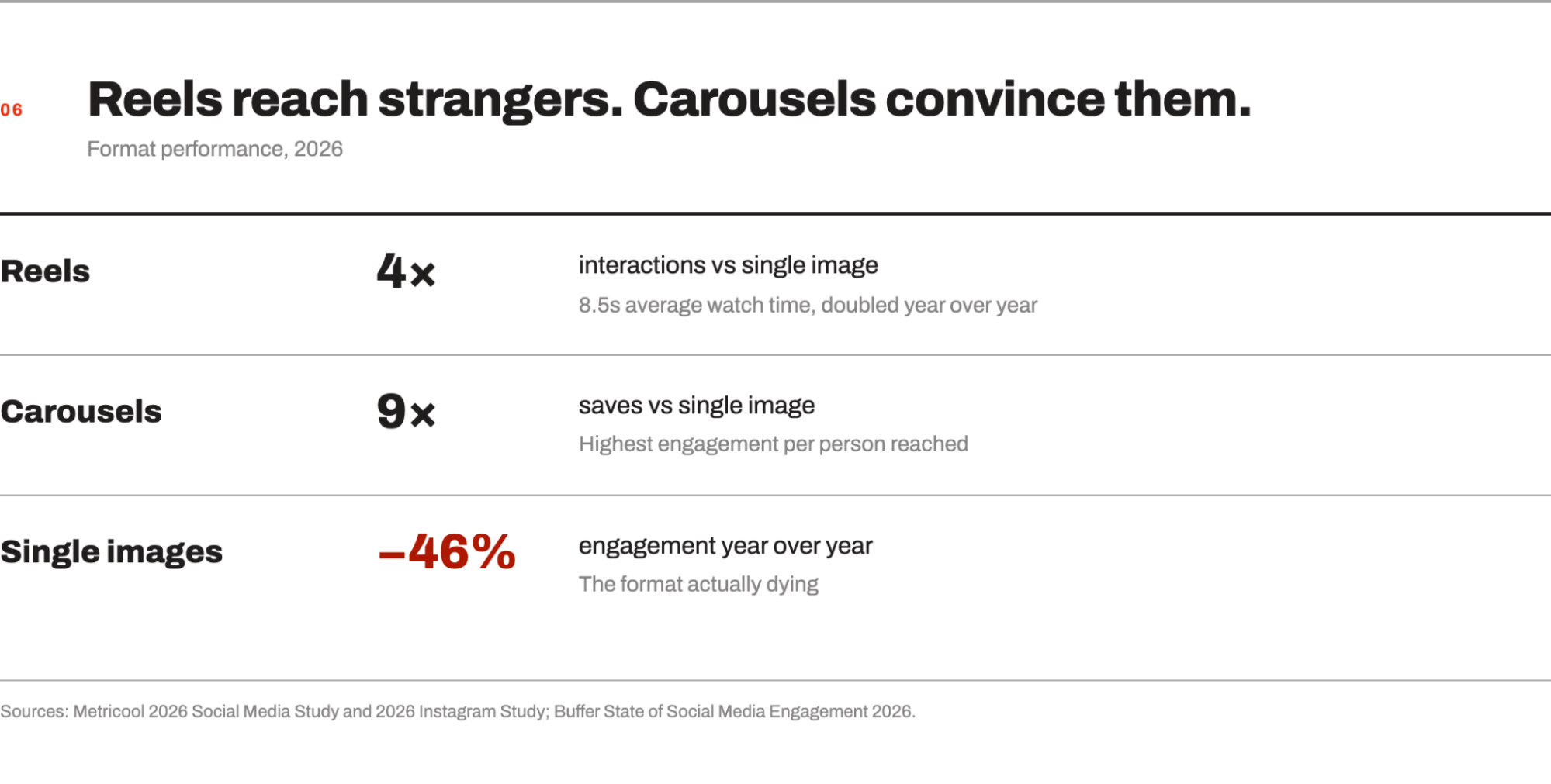
Content type matters by design. Original beats repurposed. That’s now policy, not preference (see Force 3).
The small-account advantage shows up in growth data too. Socialinsider’s 2026 Instagram benchmarks, built on 35 million posts from 447,613 pages, found brands with a few thousand followers growing at rates above 20%, slowing to around 11% for profiles approaching a million. Growth on Instagram was never linear, but the gap between small and large accounts is where the platform’s stated push toward merit-based discovery is most visible.
One honest caveat that undercuts the tidy version of this analysis: “percentage of followers reached” is a decaying metric. When a large and growing share of Reels views comes from people who don’t follow you, dividing reach by follower count measures a shrinking slice of what’s actually happening. A brand can post a Reel that reaches 40,000 non-followers and still report a “bad reach rate” because the denominator is wrong. Keep tracking it for trend continuity, but stop treating it as the headline.
How to improve Instagram reach in 2026 (and what to stop reporting)
Five moves, in order of impact. Not fifteen. Five.
- Re-anchor your reporting on views, reach, and sends, not follower-based engagement rate. This is the most important item on this list, which is why it’s first. Instagram itself has moved to views as its primary success metric. If you keep reporting likes per follower, you’ll keep reporting decline even in quarters where your actual performance improved. Rebuild the set of Instagram metrics you track around what the platform now pays for, and re-baseline your benchmarks from 2025 onwards so you’re comparing against the new normal, not the old one.
- Design for sends. What do people forward privately? Useful frameworks, saveable references, sharp takes their colleague needs to see, anything with a built-in “this is so us” recipient. One warning: Instagram penalises engagement bait, so “tag 10 friends” prompts will hurt you. Contextual share-worthiness (“send this to the designer on your team”) is fine. The difference is whether the share request is the content or a footnote to genuinely useful content.
- Win the first four seconds. Watch time is the top-weighted signal, and Dash Social’s 2026 benchmarks found audiences watch a Reel for roughly four seconds before scrolling. Metricool’s finding that average Reel watch time doubled to 8.5 seconds tells you the ceiling is rising for content that hooks, and the floor is falling for content that doesn’t. Front-load the payoff. The logo animation can wait, or better, it can go.
- Rebalance the format mix instead of going all-in on one format. Reels for non-follower discovery, carousels for engagement depth and saves, Stories for keeping your existing audience warm. Each format has a job. Judge each one against its own job, not against a single blended engagement number, and benchmark by format against competitors rather than against your own past averages, since everyone’s past averages are inflated.
- Audit your originality. Strip watermarks. Kill the low-effort repost habit entirely. If you use third-party content, transform it properly: commentary, editing, a genuine take layered on top. Instagram has said explicitly that adding a credit or a minor crop doesn’t count.
And the anti-advice, because knowing what doesn’t work saves more budget than knowing what does. Deleting and reposting underperformers doesn’t work. Buying engagement actively hurts, since it wrecks the per-reach ratios the algorithm actually reads. Posting more to outrun the decline demonstrably fails: Metricool’s panel doubled its output and lost a third of its reach.
And before blaming a shadowban, run the two-minute test: open your own Insights and look at reach from non-followers. If that number is above zero, you are not hidden. Your Instagram reach is down because you’re competing, which is a different problem with a different fix.
The honest reframe
The uncomfortable truth: 2020-era Instagram reach isn’t coming back, the same way 2015-era Facebook organic reach never came back. Platform maturity is a one-way door, and Instagram walked through it while most reporting templates stayed on the other side.
But the audience is still there. Three billion people, half an hour a day. What changed is the currency: from public likes to private sends, from follower reach to discovery reach, from volume to originality.
So when your client or your boss asks why Instagram reach is down, you now have the receipts, and a better question to hand back: are we measuring the things Instagram actually pays for? Because the accounts recovering in 2026 aren’t the ones that found a trick. They’re the ones that changed what they count.