

AI search is changing how people find brands. The old model assumed SEO drives rankings and social media drives reach, and those two barely overlapped. That assumption no longer holds. When a language model writes an answer, how does it find the right sources and where does social fit into this?
Over the past year, I analysed which sources AI models cite for brand and non-brand queries. I looked at queries across industries from construction chemicals to consumer healthcare and cosmetics. The pattern is the same across all of them. Social content is now a primary source to AI answers (Generative Engine Optimization – GEO), and the brands getting cited are paying attention.
Gen Z is already using AI for purchase decisions
The scale is what makes this urgent. ChatGPT handles around 2.5 billion prompts per day. OpenAI reported 800 million weekly active users by late 2025. Google AI Overviews reaches over 2 billion users a month, with Perplexity and Claude adding hundreds of millions more. That is not a niche trend.
Your potential customer is more likely to see an AI-generated answer than a classic Google results page. Gartner predicted traditional search volume drop 25% by 2026 as more queries shift to chatbots. A Pew Research Center report found that 34% of American adults had used ChatGPT by early 2025. That is double the figure from mid-2023. And Gen Z is leading the shift.
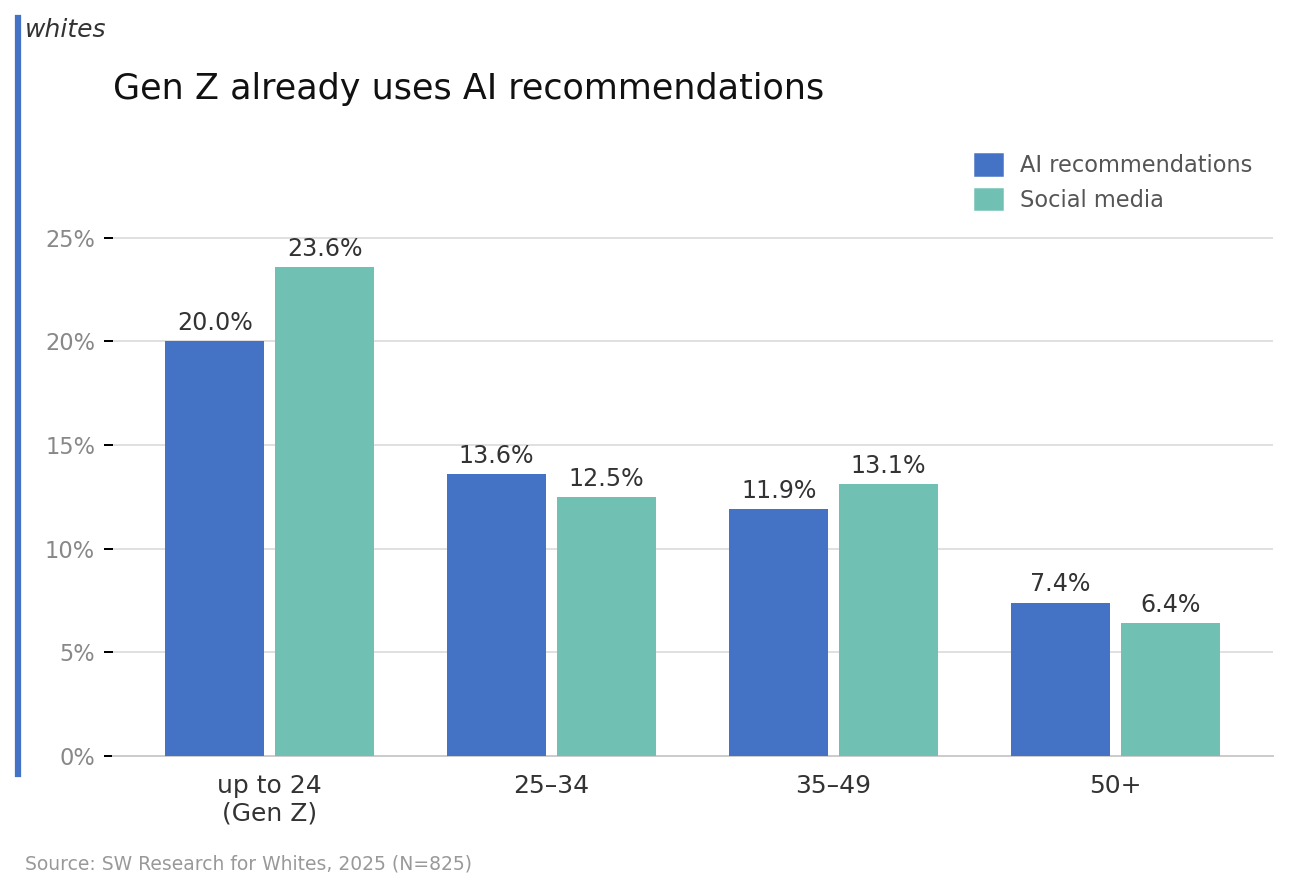
Consumers are using AI to decide what to buy. A 2025 SW Research study on AI recommendations in health and beauty found that one in five Gen Z shoppers (20%) turns to AI for product recommendations. That is more than double the average across all age groups (9.5%). For Gen Z, social media and AI are nearly equal sources of product discovery: 23.6% vs 20%. This is happening in a category where TikTok already dominates early discovery.
Why AI answers changed how brand visibility works
When a user asks ChatGPT, Gemini, or Google AI Mode about a product or service, the model does not return ten links. It shows one paragraph, built from whatever it decided was the best available material.
Being quoted is the new first position. Not being there means your brand does not exist for that query.
This means social media strategy now has to account for brand visibility in AI. Content needs to work for the person scrolling their feed and for the model processing it. A 2025 BrightEdge analysis found that pages ranked 21 to 30 in traditional organic results saw their citations in AI Overviews grow by over 400%. Nearly 10% of all AI Overview citations now come from social platforms.
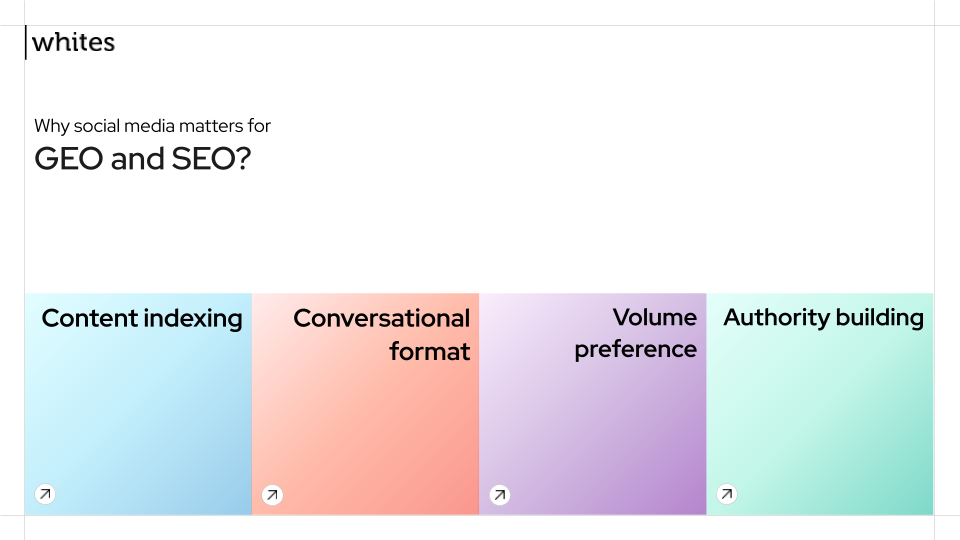
There are four things that make social content useful to a language model. None of them are accidents of the algorithm.
The first is indexing. Social platforms are fully indexed by Google and by the models themselves. A post can appear as a source on the same basis as a published article.
The second is format. Social media posts are written the way people ask questions. That matches the conversational style users bring to AI chat.
The third is volume. The more quality content a brand publishes on a topic, the higher the chance of being pulled into the answer.
The fourth is authority. A brand profile that reads like a knowledge resource gets treated as one. A profile that reads like an ad board does not.
Which platforms AI engines actually cite
A Semrush study covering over 230,000 prompts, published in November 2025, identified the most-cited domains across three major models. Across ChatGPT, Google AI Mode, and Perplexity, social media and user-generated content consistently appear in the top sources of every ranking.
An Ahrefs study of 730,000 query-answer pairs showed a clear split within Google itself. AI Overviews favor UGC from Reddit and YouTube. AI Mode reaches almost twice as often for expert medical sites and encyclopedic sources.
The most-cited domains by model, according to Semrush are:
- ChatGPT: Reddit, Wikipedia, Medium, Forbes, LinkedIn.
- Google AI Mode: LinkedIn, YouTube, Reddit, Google, Google Blog.
- Perplexity: Reddit, LinkedIn, NIH, Microsoft, Google.
A report by Averi.AI puts YouTube at around 23.3% of AI Overview citations, followed by Reddit (21%), Wikipedia (18.4%), and Google’s own properties (16.4%).
A few things are worth flagging here.
LinkedIn shows up in the top five for every model. Its share is growing in both AI Mode and AI Overview, appearing in around 15% of prompts. Reddit dominates in ChatGPT and Perplexity, but its ChatGPT citation rate dropped from nearly 60% in early August 2025 to around 10% by mid-September. That is one of the fastest source-pool shifts the Semrush study recorded.
The practical implication: a brand publishing only on Instagram and TikTok is skipping the two platforms LLM’s cite most. Sotrender’s article on creative social content for AI makes the same point from the content side: useful, distinctive content earns both user attention and model trust.
Why YouTube is the most powerful source for AI right now
If I had to pick one platform that matters most for AI visibility right now, it is YouTube. More than LinkedIn, Reddit, and even the brand blog your team has been maintaining for years.
YouTube is in the top three cited domains in Google AI Mode and AI Overview for how-to queries, tutorials, and product comparisons. In some categories it is the single most-cited source. The reason is simple: language models do not watch videos, they read transcripts. YouTube auto-generates captions for every upload and makes that text available to search engines and AI crawlers. A five-minute tutorial can end up cited alongside a long-form article.
There is also a production argument. One well-structured video gives you a native YouTube asset, a transcript that LLMs can read like an article, and a clip bank for Reels, TikToks, and LinkedIn posts. That is a lot of reach for one piece of work.
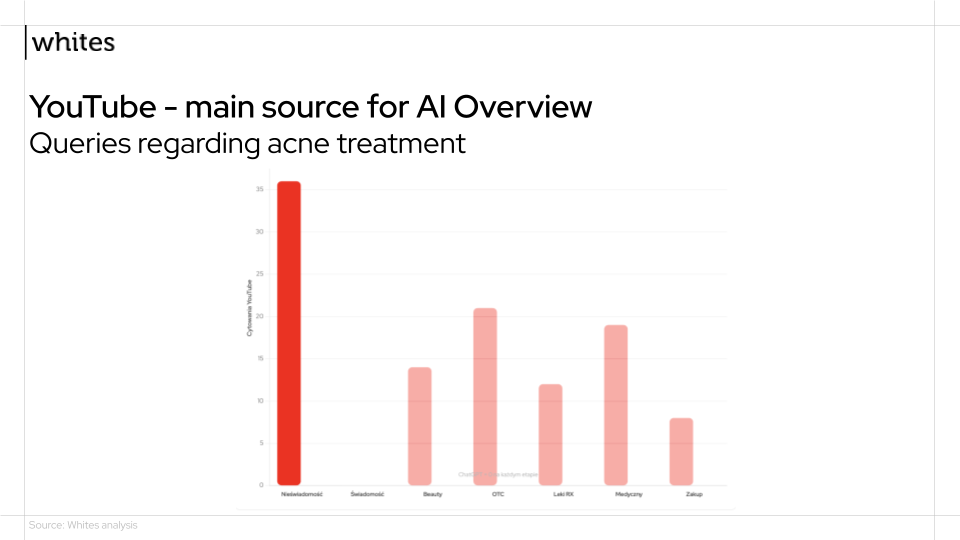
Research from Whites agency confirms this. In beauty, YouTube was the dominant source in Google AI Overview for product and ingredient queries. In construction and finishing materials, channels run by architects and contractors dominate the Sources panel for non-brand, how-to queries. In healthcare, an expert explaining a concept on YouTube consistently outranks the manufacturer’s own page for the same query.
Sotrender’s 2026 guide to Instagram video shows the same trust mechanism playing out on a different platform. Co-creation formats with creators build more credibility than standard brand communication.
If your team treats YouTube as a place to archive webinar recordings, that is probably the biggest gap in your AI visibility strategy. Expert videos published regularly, with clear chapter structures, proper descriptions, and clean transcripts, get cited more often than almost anything else you can publish.
Why LinkedIn is the most underrated AI source
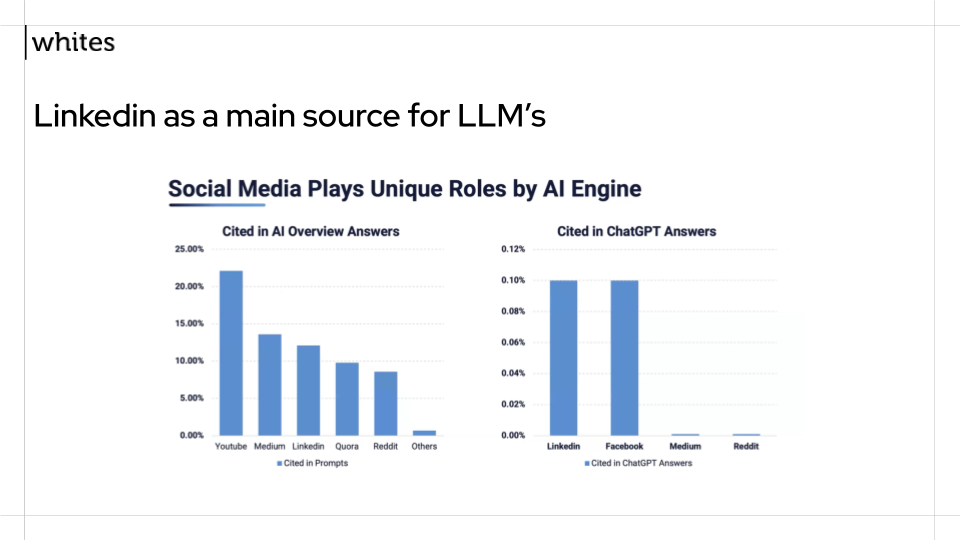
YouTube drives volume. LinkedIn drives authority.
The content brands consistently avoid writing, usually filed under ‘thought leadership’ and deprioritised every quarter, is exactly what models cite most. LinkedIn appears in the top five cited domains across ChatGPT, AI Mode, and Perplexity.
The reason is structure. LinkedIn articles are long, keyword-rich, and tied to a verified employer. That combination is hard for a model to overlook. A named-author LinkedIn article will typically be pulled over an anonymous brand blog post covering the same topic.
Take the query ‘How AI may reshape the job market?’ Google AI Mode returns a LinkedIn article written by a named person, linked to a verified employer, drawing on multiple expert perspectives. The model reads that as a credibility signal. A brand page with the same information, attributed to no one in particular, does not get the same treatment.
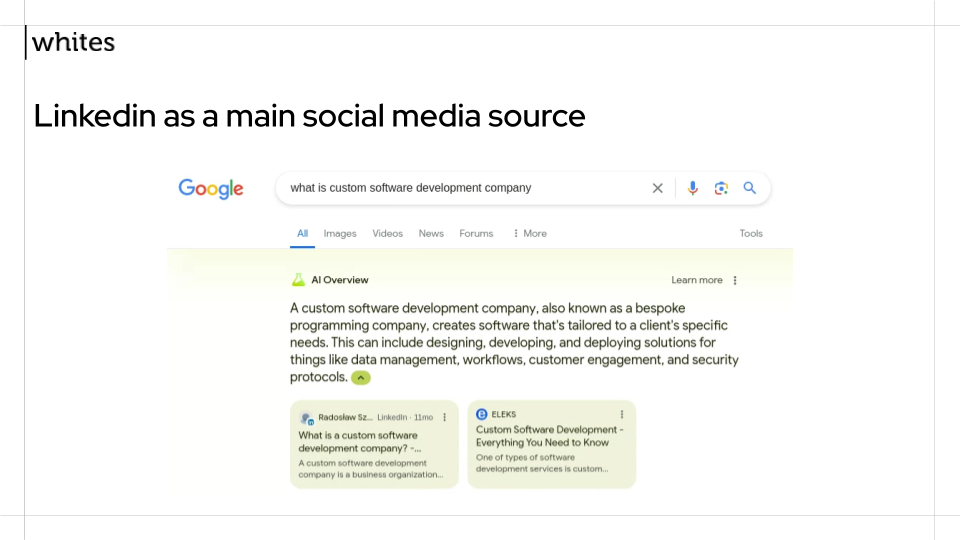
LinkedIn articles also hold their value. An Instagram Reel loses relevance within days. A LinkedIn article keeps getting cited for months. The platform indexes it as reference material rather than a feed post.
For any brand that wants to grow AI visibility, a consistent publishing rhythm from a named expert on LinkedIn is one of the more reliable moves available right now.
Different industries, different AI sources
Research from Whites agency shows that the platforms LLMs cite vary significantly by category. There is no universal best platform for AI visibility. What works in beauty does not work in B2B.
Construction chemicals, finishing materials, B2B: YouTube leads in Google AI Mode for how-to queries like ‘how to insulate a basement’ or ‘best adhesive for large-format tiles.’ Facebook still matters, mainly through professional trade groups and regional contractor communities, which models treat as legitimate industry sources.
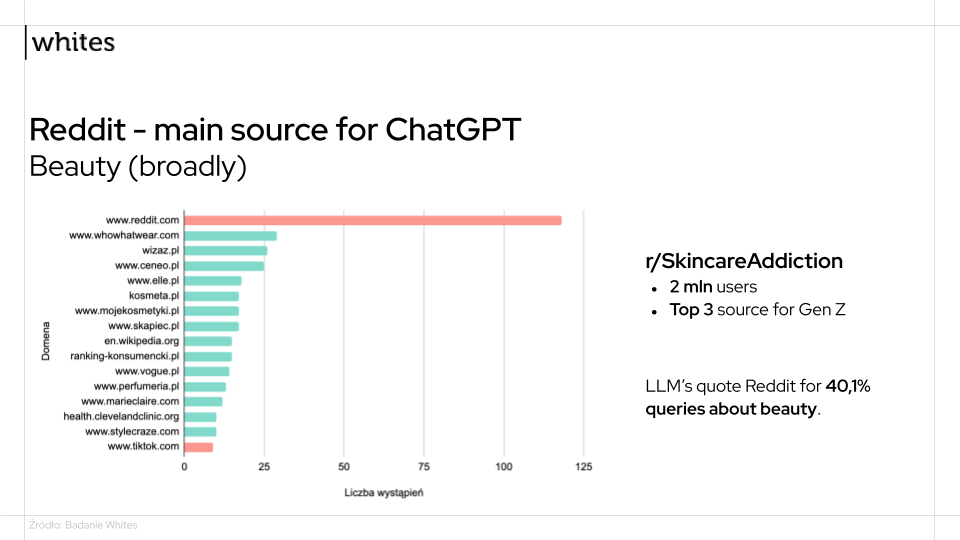
Cosmetics and beauty: Reddit leads in ChatGPT, appearing in roughly 40% of beauty-category answers. Subreddits like r/SkincareAddiction and r/AsianBeauty regularly outrank brand pages for ingredient and routine queries.
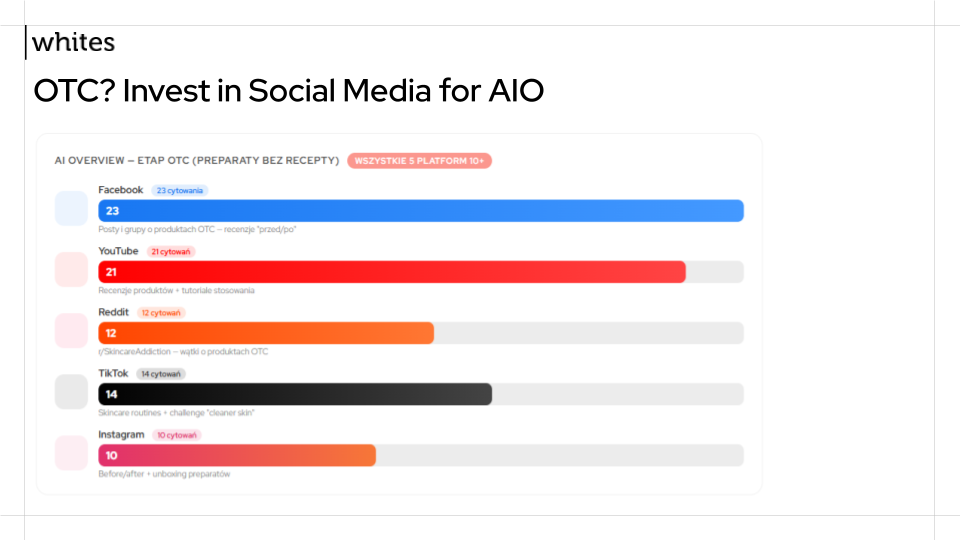
OTC: All five major platforms, Facebook, YouTube, TikTok, Reddit, and Instagram, appeared at least ten times in AI Overview. This is the only category where the model reached for every major social channel at once.
Eye health and specialist medicine: Named expert content on LinkedIn and YouTube consistently outperforms manufacturer pages. A single LinkedIn article can have more AI visibility than an entire product FAQ. The model treats author credentials as a stronger signal than brand name.
Architecture and interior design: Pinterest and Instagram drive style discovery. But when queries turn technical, ‘best flooring for a wet bathroom’ or ‘acoustic panel installation,’ models reach for YouTube tutorial channels.
The conclusion is straightforward: map the source pool for your own category. Do not borrow a strategy from a different industry and assume it transfers.
What makes content worth citing
For a language model to choose a post as a source, the content needs to meet specific conditions. Three things matter most.
Text the model can actually read. An Instagram Reel without a transcript is effectively invisible to a language model. Captions, alt text, pinned comments, and clean transcripts are what make a post indexable. This is the step most teams skip in the rush to publish. Meta’s accessibility documentation confirms that alt text and captions are indexed the same way as post descriptions.
Consistency on a topic. Models favour sources that cover a topic regularly, not ones that mentioned it once. One viral post rarely beats ten steady, clearly written ones on the same subject. To find which posts are candidates for AI citation, use Sotrender’s Content Strategy feature and filter by Engagement. Posts that generate saves and detailed comments are the ones models tend to trust. Sotrender’s article on content formats that build long-term engagement covers the same formats that LLMs favour.
Trust tied to a real person. The 2025 Edelman Trust Barometer found that trust in technical experts within companies stands at 63%. Only 47 to 50% of respondents trust content produced directly by brands. Language models reflect this pattern. Posts from named experts and real users carry more weight than brand voice alone.
Sotrender’s article on social signals AI still cannot see is worth reading when building content that needs to feel genuinely human, the kind models are more likely to treat as credible.
How to build an AI visibility plan without disrupting what already works
If you are updating your social strategy for AI visibility, these five steps are a reasonable place to start.
- Audit your source pool. Run the queries your customers are actually asking and see what appears in the Sources panel. The more queries you test, the clearer the picture. The White Dog tool was built for this kind of research and offers a free sample.
- Do not try to be on every platform. B2B brands should focus on LinkedIn articles. Beauty brands should build for Reddit and YouTube. Sotrender data shows you where your audience actually is. Start your GEO efforts there.
- Pick a named expert for LinkedIn and commit to a publishing schedule. Do not publish from the company page. You need someone willing to write under their own name and keep going. The more that name appears across related topics, the more authority the model assigns to it.
- Add text to every visual asset. Alt text, clean transcripts, pinned comments, descriptions written as answers rather than slogans. If the model cannot read it, it cannot cite it.
- Brief your creators and experts. Most do not know LLM optimisation is a factor. Ask them to state the product, context, and outcome early in every video. Require descriptions that reflect the spoken content. Models cross-reference video and text, and they reward consistency between the two.
Not every post needs to be optimised for AI
Optimising for AI visibility matters. But not every post needs to be written with a language model as the audience.
Some content exists to drive engagement. Some posts are there to stop the scroll. Some build community. Forcing a meme or a behind-the-scenes video into a ‘citable’ format breaks it, and the model is not going to cite it anyway.
A more practical approach is to split your calendar by purpose.
Relationship content, behind-the-scenes posts, memes, informal updates, should be optimised for follows and saves. AI citation is irrelevant here.
Engagement content, polls, questions, conversation starters, should be optimised for comments, shares, and direct messages.
AI visibility content, expert analysis, how-to posts, answers to specific questions, should be written to be cited: clear structure, named experts, specific numbers. If you already have a working social strategy and do not want to add new formats, designate 25 to 30% of your existing calendar as AI visibility content and apply citation principles only to those. A ready list of Instagram content ideas is a good place to look for topics. Not all of it maps to GEO, but expert and how-to formats translate well.
Test it yourself: a quick visibility audit
The fastest way to understand your brand’s position in AI search is to run a few queries and look at the Sources panel. Run each of the queries below across the main language models, screenshot the Sources panel, and compare. Twenty minutes gives you a real picture of where your category stands.
Five queries worth running:
- ‘What’s the best [product category] for [specific audience]?’ Example: ‘What progressive lenses are best for first-time wearers?’ Expect Reddit to appear in at least one source.
- ‘How do I [solve the problem your category solves]?’ Example: ‘How do I remove cement residue from new tiles?’ Expect YouTube to dominate.
- ‘Is [category] worth it?’ Example: ‘Do blue light filters actually work?’ In ChatGPT, answers often draw heavily from Reddit.
- ‘[Competitor] vs [competitor]: which should I choose for [use case]?’ Several social platforms usually appear here.
- ‘What’s the difference between [your product type] and [competing product type]?’ Example: ‘What’s the difference between cement grout and epoxy grout?’ Facebook may show up in this one.
Save the sources from every test and run them again in a few months. The source pool shifts, and those screenshots give you something concrete for any conversation about AI visibility.
AI visibility: what to do today
AI search has become a primary channel for brand discovery. The answers your customers see are built from a source pool that social media shapes directly. The brands getting cited are not necessarily the ones with the most polished content. They are the ones publishing consistently in the formats and places models actually read.
You do not need to rebuild your social strategy from scratch. Split what you already have: keep the posts that build engagement and community. Add the elements that drive AI visibility. Then measure what actually makes it into the Sources section.
If you want to know which of your posts appear in AI answers, which formats are gaining traction, and how your content compares to competitors, Sotrender can help you measure that.
Someone in your industry is being cited by language models today. It is worth finding out whether that is you or your competition.


