

Open any social feed right now, let’s say Instagram, and you’ll notice something. There’s more content, but it’s starting to look the same.
AI tools have made publishing fast and cheap. Teams that once needed a week to produce a post can now do it in an hour. That’s genuinely useful.
But it has also created a problem. On-trend content now sounds monotonous and does not inspire the same brand reach as before.
If you want to cut through right now, you need to treat AI as a production tool, while keeping the thinking, the voice, and the stories firmly human.
In this article, we’ll discuss how to do that, retain your brand’s creativity, and measure success with real metrics using Sotrender.
- 7 days for free
- No credit card required
- Access to all premium features during trial

What AI Actually Changes About Social Content
AI has made certain parts of content creation much less painful.
Talk about pattern recognition, posting time recommendations, caption variations, transcription, caption generation, audience segmentation, and first-draft copy. AI removes friction in these areas and even opens up visual production to teams without dedicated designers.
According to McKinsey’s research on the economic potential of generative AI, marketing and sales are likely to see the highest productivity gains from AI tools across all business functions.
Where AI Runs Out of Road
At the moment, AI can’t read a cultural moment the way your audience does. It flattens regional nuance, misses the subtext in your community’s language, and produces content that technically ticks every box yet feels like it was made by nobody in particular.
Heinz figured this out early. In 2022, agency Rethink asked DALL-E 2, “What does ketchup look like?” Every result, across every prompt style, came back looking like a Heinz bottle.
The brand turned that insight into a full campaign, then invited its audience to submit their own AI ketchup prompts. The result was 850 million earned media impressions and 38% higher social engagement than in their previous campaigns, according to The Drum’s coverage.
The unintended push earned Heinz publicity. But the point remains that AI is still largely monotonous and rigid with its output. So, it should never be your primary brain. Only use it as an assistant and take advantage of its production capacity, just like Heinz did.
6 Creative Ways to Make Your Social Content Stand Out
If you want your content to stand out on social media in an AI-heavy era, here’s what to do:
Lead With Human Stories
The posts that people save, share, and come back to almost always have a person at the center.
- Your brand’s founder’s honest admission
- A customer’s unexpected outcome
- A behind-the-scenes moment that wasn’t staged
Those things cut through because they can only be lived, not generated.
Conrad Wang, Managing Director at EnableU, a personalised aged care and NDIS disability support provider serving participants and families across Australia, sees this play out every day.
“The people we support often have powerful stories that rarely get heard outside their immediate circle. When we share a genuine participant experience on social, the response from families, carers, and the wider community is completely different from anything polished or pre-planned. Authentic stories like these create the kind of engagement that no amount of scheduling can manufacture.”
To find stories worth telling, go where the real feedback lives. Your support inbox, your community comments, your customers’ first-use experiences. Mine those for the moments that feel specific and slightly unfinished. The more it sounds like an actual person, the more it will land.
A few practical starting points:
- Interview real customers: Ask them about the first time they used your product, the problem they were trying to solve, and what actually surprised them. Use their language.
- Document behind-the-scenes moments: Not just the polished ones. The iteration, the mistake that led somewhere interesting, the conversation that changed your thinking.
Once you have a real story, AI can help you turn it into a carousel, a thread, a script, or a caption. The story still has to come from a person.
Use AI as a Thinking Partner
The most useful framing is that AI is fast and tireless, but needs direction. Left alone, it produces content that sounds plausible but rarely says anything worth reading. Give it a strong brief, your audience’s actual concerns, and your brand perspective, and it becomes a useful first-draft engine.
Jeffrey Zhou, CEO and Founder at Fig Loans, an online installment lender offering transparent, affordable personal loans as an alternative to payday products, creates content for people navigating financially stressful decisions.
“Our customers come to us when money is tight, and options feel limited. Content that sounds automated or generic doesn’t connect with them at all. So while we might use AI to quickly test different idea angles, the message that actually lands comes from understanding what someone is thinking when they’re searching for a loan. You have to understand the person before you can write for them.”
A workflow that actually holds up:
- Start with your sharpest insight about your audience’s situation, not a general topic
- Ask AI for 15 to 20 variations on a hook or opening line based on that insight
- Pick the two or three that sound closest to how your audience actually talks, not the cleanest-sounding ones
- Test them across formats and let engagement data tell you what resonated
- Double down on the winner with new angles, and retire what fell flat
Mix your understanding of the audience with the data. That combination is where the useful direction comes from.
Build a Voice Nobody Can Copy
A recognizable voice is the one thing AI cannot generate for you. It takes too long to develop, it’s too specific to your history, and it lives in details that have never been written down anywhere. But if you document it well enough to feed into your prompts, it becomes a real advantage.
Kashif Ali, Growth Specialist at PsychologySchoolGuide.net, a comprehensive resource guiding students toward accredited psychology programs and career paths across the US, creates content for people making significant educational decisions.
“Students looking at psychology programs are comparing dozens of sources at once. That means generic education content blends into the background immediately and is quickly forgotten.”
“What we did differently was define our tone, the vocabulary we use, and what we never publish. In return, AI helps us move faster, but only because the voice guidelines exist first. You can apply the same approach to your social content as well. Without them, you just produce more content that sounds like everyone else.”
A simple voice kit worth building:
- Three to five voice traits with one-line descriptions and a short example of what on-voice and off-voice looks like for each
- A short phrase library including signature terms, words you avoid, and tone examples from your best-performing posts
- Formatting rules covering punctuation habits, CTA style, how you handle humor, and how formal or casual you get by platform
- Before and after examples showing the difference between a generic version and your version of the same post
Paste this into your AI prompts before generating anything. Then edit the output for rhythm and specificity until it sounds like you chose every word.
Make Visuals That Feel Real
Generative AI tools like Gemini and Claude have put visual production within reach of any team. That’s genuinely useful for quickly exploring directions, generating background assets, or iterating on layouts. The issue is that AI-only visuals tend to look like AI-only visuals, and audiences are getting faster at spotting them.
If you want to stand out, you need to blend AI-assisted polish with real-world texture. Phone photos, actual product shots, candid team moments, customer-sent content, all of it signals that a person is behind the account.
Sixin Zhou, Marketing Manager at LDShop, a trusted game top-up platform serving titles including Genshin Impact, PUBG Mobile, and Honkai: Star Rail across global markets, creates content for an audience with high visual standards.
“The visual bar in gaming content is high. That means AI-generated social media graphics that haven’t been customized to the game, the platform, and the community stand out for all the wrong reasons. Gamers quickly notice that. So, we use AI to explore concepts quickly, then layer in game-specific references and community language. That combination works in ways that generic AI visuals alone never do.”
What helps in practice:
- Build a consistent visual system including your color palette, type choices, framing habits, and motion style. AI can generate within that system if you describe it clearly
- Keep humans on story beats and pacing. Use AI for layout iterations, background generation, and fast cuts. Keep the narrative decisions with your team
- Mix real assets with AI-assisted polish. A real photo of your product with an AI-enhanced background reads more authentically than a fully generated scene
Most importantly, design for the platform. What performs on TikTok is visually different from what performs on LinkedIn. Account for that in every asset.
Let Your Customers Tell the Story
Someone sharing a genuine experience with your product, unprompted, in their own voice, is doing something fundamentally different from anything your team produces. Audiences know it when they see it, and they respond differently to it.
Bryan Henry, President at PeterMD, one of the largest online men’s health clinics in North America, operates in a space where patient outcomes drive trust.
“Men talking openly about their TRT results on Reddit and TikTok reaches people we could never reach with paid content. That content exists because the results are real. We make it easy for patients to share their experience, we celebrate the people who do, and we stay completely transparent about what the outcomes actually look like. Patient-generated content performs the way it does because it cannot be manufactured.”
To build a UGC flywheel that keeps moving:
- Give people a reason and a prompt. Specific questions get specific answers. Ask about their first experience, a specific outcome, or a before-and-after comparison
- Celebrate contributors visibly. Reshare, credit, and respond. People participate when they know they’ll be seen
In addition, always get rights before repurposing content on your own channels
Track What Actually Works
More content means more noise in your own data. If you don’t have a consistent way to measure which posts are actually driving outcomes, versus which ones just generate impressions, you end up publishing based on what feels good to post rather than what your audience consistently responds to.
Andrew Bates, COO at Bates Electric, a licensed electrical contractor with an A+ BBB rating, serves residential and commercial clients and represents the kind of business that came to social analytics from a practical, not a theoretical, direction.
“We’re electricians. Social media analytics was not something we thought about for a long time. But when we started tracking which posts were generating actual call inquiries versus just getting likes, everything changed. The posts that get the most shares are rarely the ones that generate calls. Knowing the difference completely changed what we prioritize.”

Now to the big matter. While most social platforms provide basic native analytics, they only cover the fundamentals, such as likes and shares.
If you want more comprehensive analytics, centralized performance, your different socials in one view, competitive benchmarking, audience demographics, and reports, Sotrender is your best go-to.
Our Interactivity Index is a proprietary engagement metric not available in native tools, and its automated reporting is worth looking at for any team producing regular performance updates. You can start a free trial here to see what your numbers look like across channels.
A few things worth tracking consistently:
- Saves and shares over likes. Saves signal genuine value. Shares signal content people want their network to see. Likes are the lowest-cost interaction.
- Engagement by content type. Are your carousels outperforming your single images? Are your educational posts driving more saves than your promotional ones?
- Performance by posting time and day. Native analytics shows you the basics, but cross-platform tools help you see patterns you’d miss otherwise.
You should also follow up on reply quality. A post with 10 thoughtful replies is often, from a community-building perspective, performing better than one with 200 fire emojis.
3 Brands Getting AI-Assisted Content Right
Let’s quickly see a few brands maintaining creativity on social media despite the AI boom.
Heinz: Using AI to Prove a Brand Truth
We’ve briefly talked about this before. But this is how it fully played out.
In 2022, Rethink agency asked DALL-E 2 what ketchup looks like. Every result came back looking like a Heinz bottle, regardless of the requested visual style. The campaign took that discovery and turned it into a full social and digital campaign built entirely from AI-generated images, then invited the public to submit their own ketchup prompts.
The result was 850 million earned media impressions, a 38% higher engagement rate than previous Heinz campaigns, and a 2,500% return on media investment, according to The Drum’s awards coverage.
What made it work was not the AI. It was a human insight: when people think of ketchup, they think of Heinz. AI proved it. The campaign made audiences feel as if they had discovered that truth themselves.
Coca-Cola: Turning Brand Assets Into a Participation Engine
In March 2023, Coca-Cola launched “Create Real Magic,” a dedicated platform that allowed anyone to use the brand’s historical visual assets, including iconic Santa Claus imagery, the contour bottle, and polar bears, to generate original AI artwork. The best submissions were displayed on digital billboards in Times Square and Piccadilly Circus.
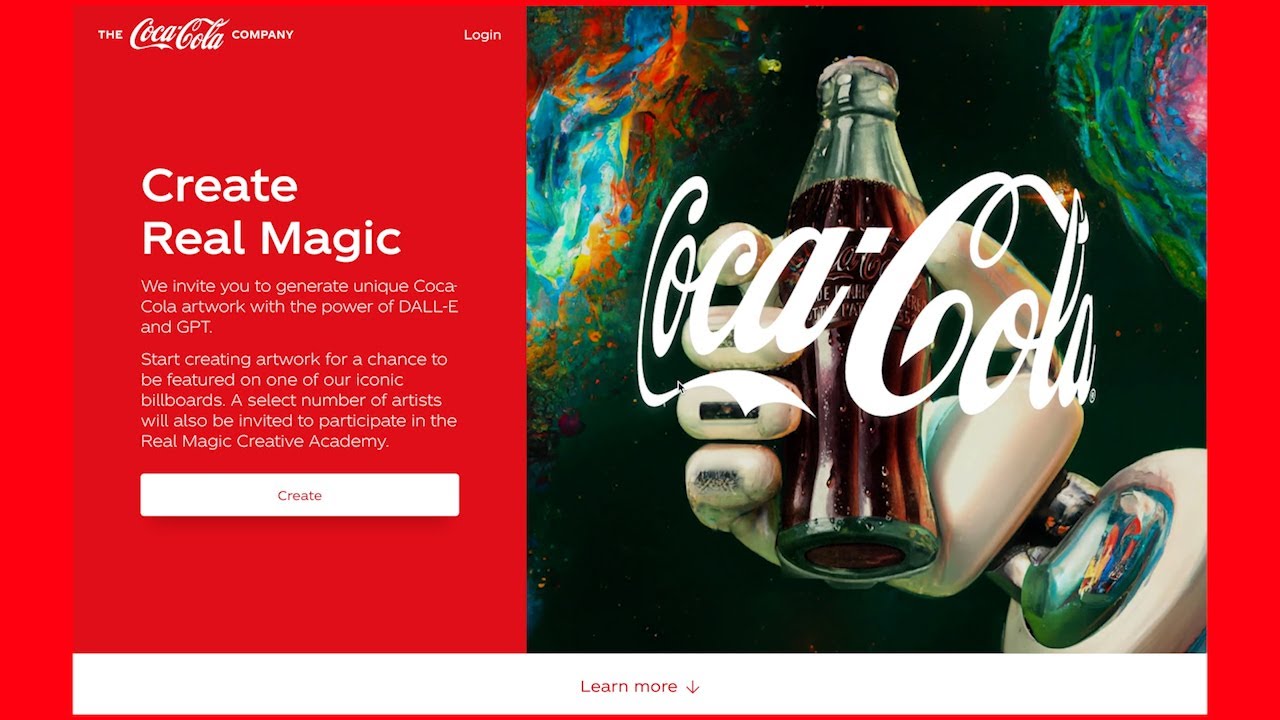
The holiday version of the campaign reached more than 1 million users across 43 markets in three weeks, according to a Microsoft case study. Coca-Cola’s Q1 2023 revenue grew 5%, and Q2 grew a further 6%.
The insight was that the brand’s archive was underused as a creative resource. AI lets fans access it and create with it, rather than just being shown it.
Popeyes: Turning a Competitor’s Move Into a 3-Day Campaign
When McDonald’s announced the return of its Snack Wrap in July 2025, exactly one day after Popeyes launched its own Chicken Wraps, Popeyes responded with a full AI-generated rap diss track in under three days.
The video, created with AI filmmaker PJ Accetturo, used Suno for the music and Veo 3 for the video, featuring surreal visuals, a clown character representing McDonald’s mascot, and a chorus that read: “Food be tasting funny when the clown be in the kitchen.”
The video racked up 3.1 million TikTok views, reported TechRadar’s coverage. The public reaction was split, with some viewers criticizing the use of AI over real performers, while others saw it as exactly the kind of fast, bold response a competitor launch deserved.
The lesson from Popeyes is more nuanced than a win or a loss. AI gave the brand the ability to respond in real time at a scale that would have taken weeks through traditional production. Whether audiences accept that trade-off depends entirely on how much your brand voice and cultural credibility can carry the format.
Conclusion
More content has never been, and should never be, the goal. Your content goal is to create something that makes people stop, engage, and come back.
While AI has changed how fast you can produce that, it hasn’t changed what makes people care. If you want to pull ahead, you should invest harder in gathering real stories, building a distinctive voice, prioritizing genuine community building, and ensuring honest performance tracking.
Start with one section from this article that reflects where your biggest gap actually is. Fix that first. Build from what the data tells you next.