

You post a TikTok that took real effort. The hook works, the edit feels tight, and the idea actually helps your audience. Then it gets a few hundred views, reaches the wrong people, or disappears after one weak push. That’s usually when TikTok hashtags start to feel either magical or pointless.
The truth sits in the middle. Hashtags can help TikTok understand your video, connect it to search behavior, and place it near relevant conversations. But they only help when they match the content, audience, and intent behind the post.
You’ll learn
- How TikTok hashtags work in search, discovery, and topic categorization
- How many hashtags to use without making your caption look spammy
- How to combine broad, niche, branded, and trend-based hashtags
- How to choose hashtags for creators, brands, agencies, and ecommerce accounts
- How to check whether a hashtag fits your video before posting
- How to connect hashtags with TikTok analytics
- How to troubleshoot weak hashtag performance
- How Sotrender helps you analyze TikTok content beyond surface-level views
What TikTok hashtags actually do
TikTok hashtags help group content around a topic, trend, community, product category, or user intent. They make your posts easier to understand for both the platform and the viewer.
That does not mean hashtags push a weak video to millions of people. TikTok also looks at watch time, rewatches, engagement, account history, video topic, captions, on-screen text, audio, and viewer behavior.
Think of hashtags as labels, not engines.
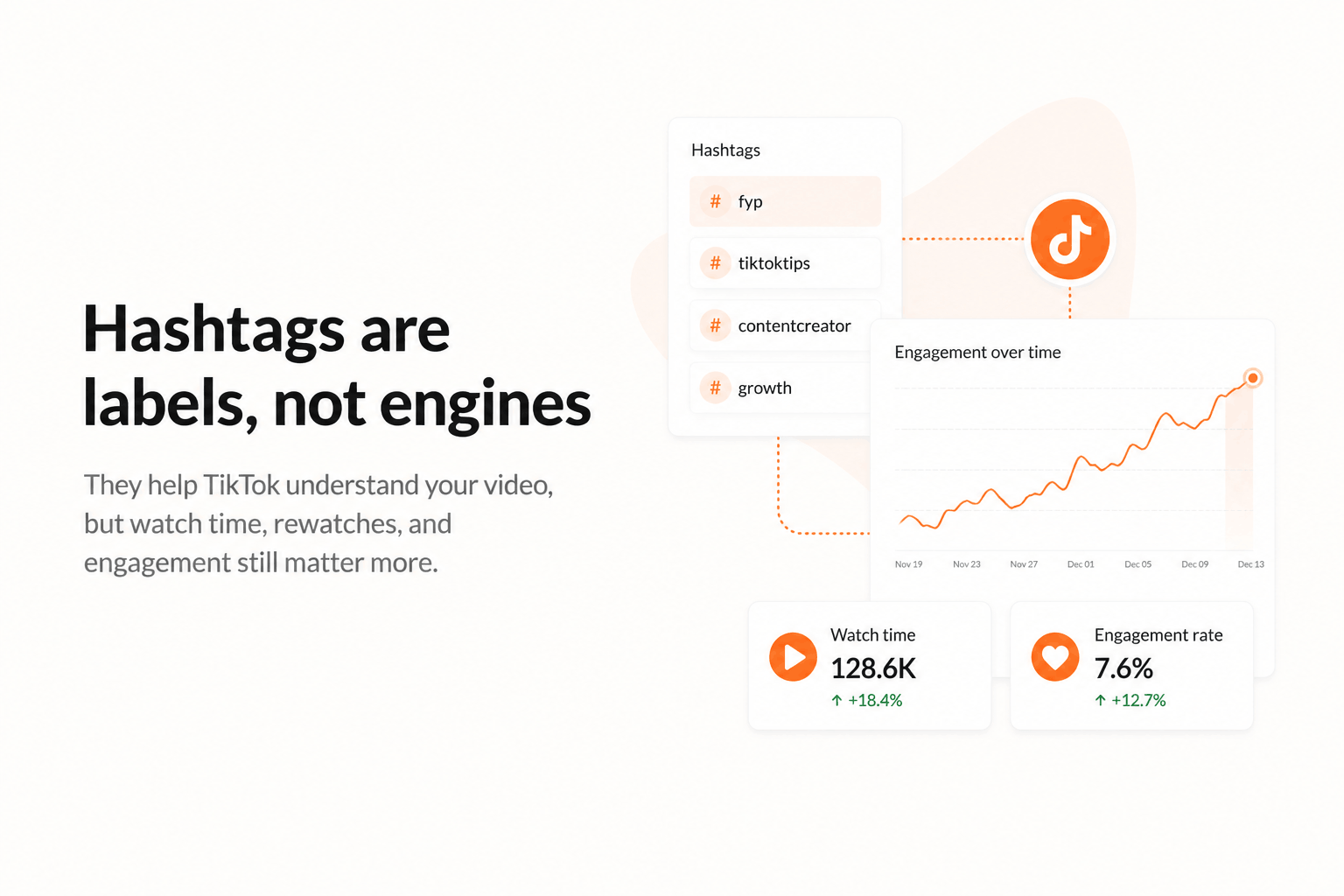
If your video explains how to improve TikTok engagement, hashtags like #tiktokengagement, #socialmediatips, and #tiktokstrategy give the platform useful context. If the same video uses only #viral, #funny, and #fyp, the signal becomes vague.
It’s important to know how to use hashtags if you want each tag to support discovery rather than just fill space in the caption.
- 7 days for free
- No credit card required
- Access to all premium features during trial
TikTok hashtags vs captions vs keywords
TikTok hashtags are only one part of discoverability. Your caption, spoken words, and on-screen text also influence how TikTok understands the post.
A clean hashtag strategy works best when all these elements point in the same direction.
This is why hashtag advice often feels incomplete. If the caption says one thing, the video says another, and the hashtags chase a third topic, TikTok gets a messy signal.
Before you build a repeatable process, it helps to clarify what hashtags are and why they matter across social platforms.
How many TikTok hashtags should you use?
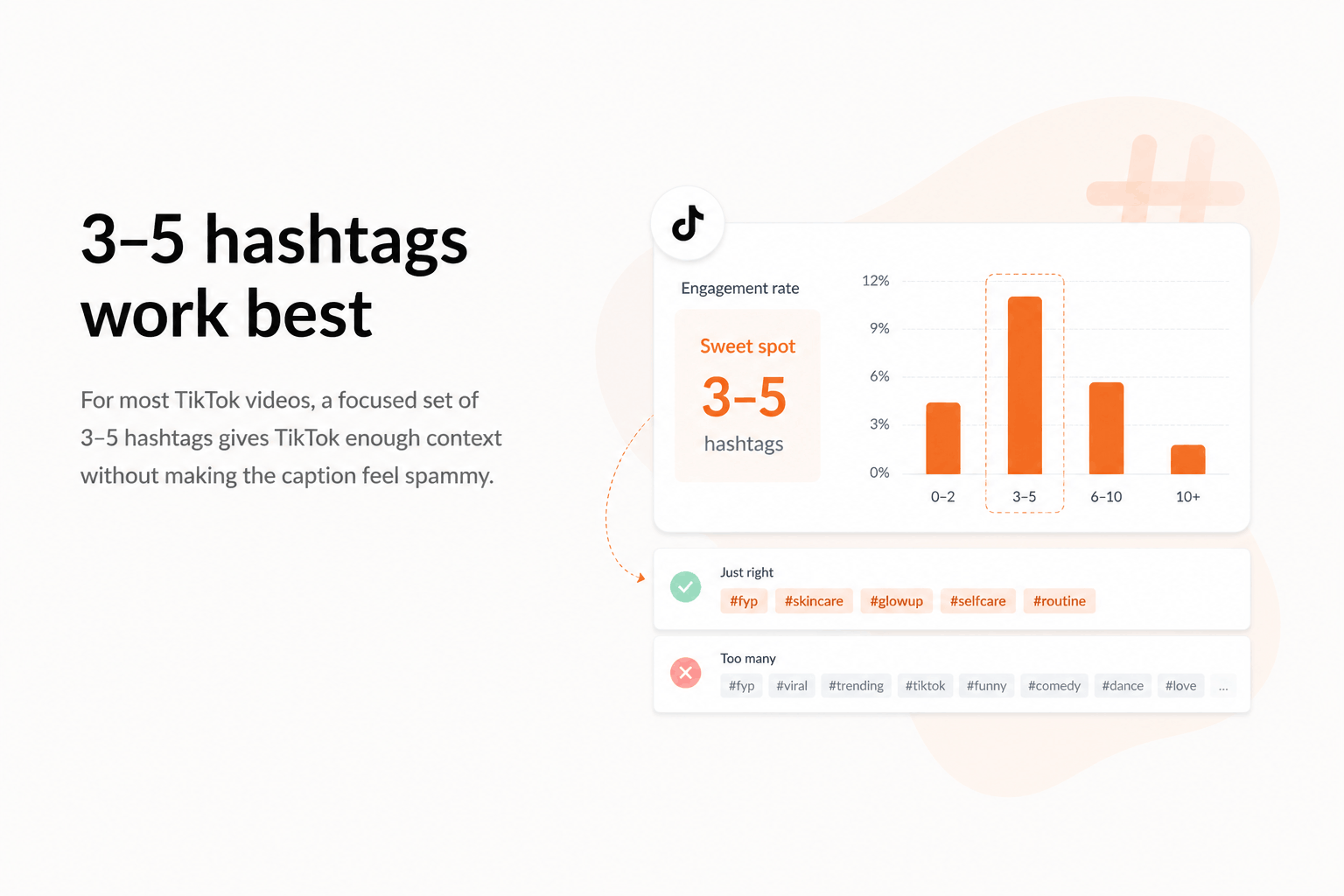
Most videos do not need ten or fifteen hashtags. For many accounts, three to five focused hashtags are enough.
This range gives TikTok enough context without making the caption feel stuffed. It also forces you to choose tags with purpose.
A good hashtag set usually contains a broad category tag, a niche tag, an intent-based tag, and a trend or branded tag when it truly fits. You do not need every role in every post. A simple tutorial may need only topic and audience tags. A campaign post may need a branded hashtag plus a category tag.
hashtags
hashtags
hashtags
hashtags
TikTok moves fast, so brands need to understand the TikTok algorithm instead of relying on old hashtag habits.
Types of TikTok hashtags
TikTok hashtags work better when each tag has a specific job. Do not use five hashtags that all say the same thing in slightly different words.
Broad category hashtags
Broad hashtags describe the larger topic. Examples include #marketing, #fitness, #skincare, #booktok, #travel, and #foodtok.
They can help TikTok place your content inside a large conversation. They also come with heavy competition, so they rarely work well alone.
A SaaS marketer can use #marketing, but #b2bmarketing or #saasmarketing will usually send a clearer signal.
Niche hashtags
Niche hashtags describe a more specific audience, problem, product, or use case.
Examples include:
- #coldemailtips
- #beginnerpilates
- #curlyhairroutine
- #shopifytips
- #tiktokanalytics
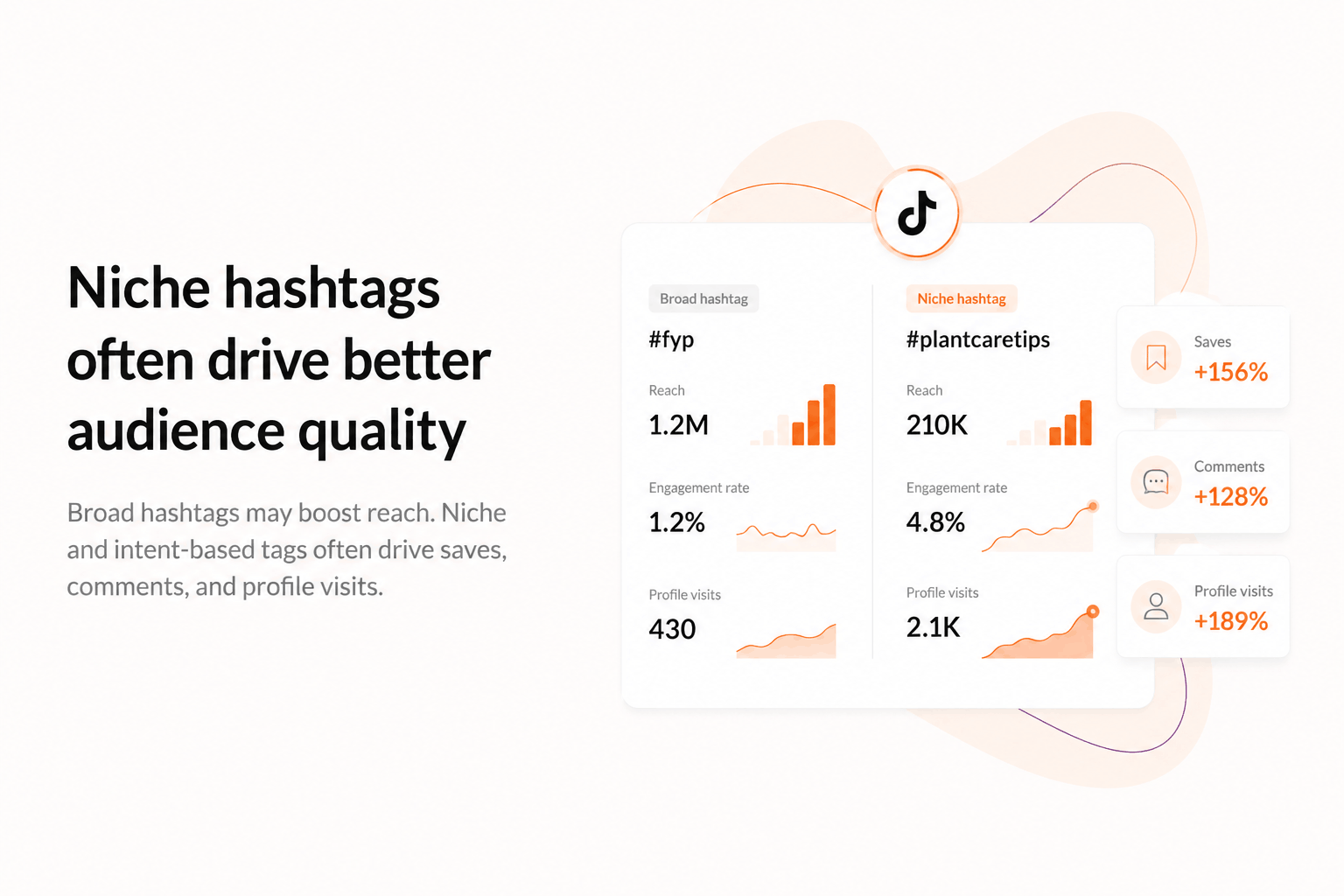
Niche tags may have smaller reach, but they often bring better audience quality. That matters when you want followers, leads, saves, or profile visits rather than random views.
Trend-based hashtags
Trend hashtags connect your video to active conversations, formats, events, or seasonal moments.
They can work well when your creative genuinely fits the trend. They can backfire when used as decoration.
Trend tags only make sense when you know how to use TikTok trends without copying formats that do not fit your brand.
Branded hashtags
Branded hashtags belong to a company, campaign, event, product, creator series, or community.
They work best when people have a reason to use them. A branded hashtag can help gather user-generated content, organize challenge entries, or create a repeatable content series. For event-based campaigns, branded hashtags can also connect social activity with registrations, ticketing, group collections, or event payments, especially when the campaign has an offline or community-driven element.
And for a new brand, branded tags should not replace descriptive discovery tags. Pair them with topic-based hashtags so new audiences can still find the content.
How to build a hashtag set for one TikTok video
The easiest way to choose TikTok hashtags is to start with the video’s job. Many creators do the opposite. They find a list of “best hashtags,” paste a few popular ones, and hope TikTok figures it out.
Start with one sentence:
“This video helps [audience] do [specific thing].”
For example:
“This video helps beginner Etsy sellers understand shipping profiles.”
That sentence already gives you useful hashtag ideas:
- #etsysellertips
- #etsyshipping
- #smallbusinesstips
Then add one broader category tag if it still fits. In this case, #smallbusiness may work. #entrepreneurlife may feel too loose.
Next, add one or two niche tags. These often matter most because they describe the exact audience or problem.
Finally, check whether a trend, campaign, or format tag applies. If the video follows a “day in the life” format, joins a seasonal shopping moment, or belongs to a branded series, add that context.
This process takes more thought than copying a hashtag list, but it creates cleaner signals. Over time, it also helps you understand which topics your account can own.
Hashtags work better when they support a broader TikTok marketing strategy, not when they sit at the end of random posts.
How to research TikTok hashtags before posting
Hashtag research should not turn into a slow, overbuilt process. You need a quick check that prevents bad matches.
Start inside TikTok search. Type the main phrase from your video and look at suggested searches. These suggestions show how people phrase the topic.
If your video covers email deliverability, search terms like “email deliverability,” “email bounce rate,” and “cold email setup.” The search language may point to stronger hashtags than a generic social media tool.
Then tap the hashtags you plan to use. Look at the videos under each one.
Check the format, not only the view count. Are the top videos tutorials, product reviews, entertainment clips, reactions, or trend edits? If your video feels completely different from the content inside that hashtag, the tag may not help.
Also check recency. Some hashtags have old viral videos but little current activity. Trend tags age fast, so freshness matters.
If your team struggles to plan posts around real audience interest, start with stronger TikTok content ideas before choosing hashtags.
TikTok hashtags for different content goals
Different goals need different hashtag logic. A video made for saves should not use the same tags as a product teaser, a trend response, or a campaign post.
Recruitment content is a good example. A brand posting about hiring, workplace culture, or candidate experience may use a different hashtag set than a product-led video. For teams using tools like HirekAI AI assistant, hashtags around planning will usually make more sense than broad business tags.
tutorial
discovery
reach
content
participation
campaign
This is where brands often get lazy. They use one hashtag set across every post because it saves time.
But a behind-the-scenes hiring video, product explainer, customer story, and trend reaction do not serve the same audience intent. They need different tags.
TikTok hashtags for brands and agencies
Brands need more structure than solo creators. As TikTok content starts to influence search results, social discovery, and AI-generated recommendations, some teams also monitor how their brand appears beyond native analytics with an AI brand mentions service.
A creator can test loosely and change direction fast. A brand usually has campaigns, stakeholders, approvals, and reporting goals.
Start with a hashtag bank. Keep it practical, not bloated.
Group hashtags around content pillars, product categories, audience segments, locations, campaigns, creator partnerships, and recurring series. For larger teams, this often turns into light scenario planning: which hashtags support evergreen education, which ones support launches, and which ones only make sense during a short trend window.
A project management SaaS brand might have one group for productivity content, another for remote work, and another for product education.
The productivity group could include #productivitytips and #workflowtips. The product education group may include feature-specific tags. Founder-led content may use #saasfounder or #startupmarketing if the post truly fits that conversation.
Agencies should create client-specific rules.
A beauty brand can use trend tags more freely than a cybersecurity company. A restaurant should use location hashtags often. A B2B platform may need industry, pain point, and use-case tags instead.
The most important rule is simple: TikTok hashtags must match the account’s audience and the post’s purpose. Otherwise, you may win views that never turn into anything useful.
How Sotrender helps you measure TikTok hashtags and content performance
Choosing TikTok hashtags is only half of the work. The real value comes from checking whether those hashtags help you reach the right people.
That is where Sotrender’s TikTok analytics can support the process.
Views can look good on the surface, but they do not always prove that your hashtag strategy works. A broad hashtag set may bring a larger audience, yet still attract people who scroll away, ignore the profile, or never engage with another post.
A more useful question is simple: did the hashtags help the video reach people who watched, commented, saved, followed, or clicked?
Sotrender helps teams analyze TikTok performance beyond single-post vanity metrics. You can track post results, compare content formats, monitor engagement, and see which topics perform better over time. That makes it easier to decide whether your TikTok hashtags support your strategy or only create short-term reach.
This matters especially for brands and agencies. When you manage several campaigns, you need more than a native dashboard screenshot. You need to compare posts, spot repeatable patterns, and explain why certain content deserves more investment.
For example, you can compare videos with niche hashtags against videos with broad discovery hashtags. If niche tags bring fewer views but better engagement, stronger audience actions, and more relevant comments, they may be the better choice. If trend-based tags create reach but no follow-through, you can limit them to formats where they actually fit.
That’s also why it helps to connect hashtags with wider performance metrics. Track TikTok analytics, review TikTok post analytics, and monitor TikTok engagement rate before changing your whole hashtag strategy.
Hashtags should never sit outside performance analysis. They should help you answer a practical question: which topics, formats, and audience signals actually move the account forward?
How to measure whether your hashtags work
TikTok does not always tell you that one specific hashtag caused one specific result. So measurement needs a practical approach.
Do not judge hashtags one post at a time. Review groups of posts.
Compare posts with broad tags against posts with niche tags. Compare trend tags against evergreen search tags. Compare branded campaign tags against regular topic tags. Compare two hashtag sets used for similar video formats.
Then look at the real outcome. Views matter, but they do not tell the whole story.
Track:
- average watch time
- completion rate
- saves
- comments
- shares
- follower growth
- profile visits
- website clicks
- product clicks
- quality of comments
A hashtag set that brings views but no comments, saves, or shares may hurt your engagement quality more than it helps. If your content reaches people but they do not follow, review how to get more followers on TikTok before changing every hashtag.
For reach-focused campaigns, hashtags should support the same goal as your plan to get more views on TikTok.
The role of #fyp, #foryou, and viral hashtags
#fyp and #foryou still appear everywhere because creators associate them with reach. The issue is not that these hashtags are always useless. The issue is that they are too broad to explain your video.
If your video has strong retention, comments, shares, and relevance, it can reach the For You feed without #fyp. If your video loses viewers in the first seconds, #fyp will not save it.
A focused hashtag like #tiktokanalytics or #runningtips tells TikTok more than #viral. It also tells the viewer more.
You can still test a broad tag inside a focused mix. But if your whole hashtag set depends on #fyp, #viral, and #trending, you are not giving TikTok much to work with.
TikTok hashtags and posting time
Hashtags help classify the video. Timing helps give the video a fair first test.
If you post when your audience is inactive, the video may struggle to collect early signals. That can make the hashtag strategy look worse than it is.
This does not mean there is one universal best time. Your audience, region, niche, and content format all matter.
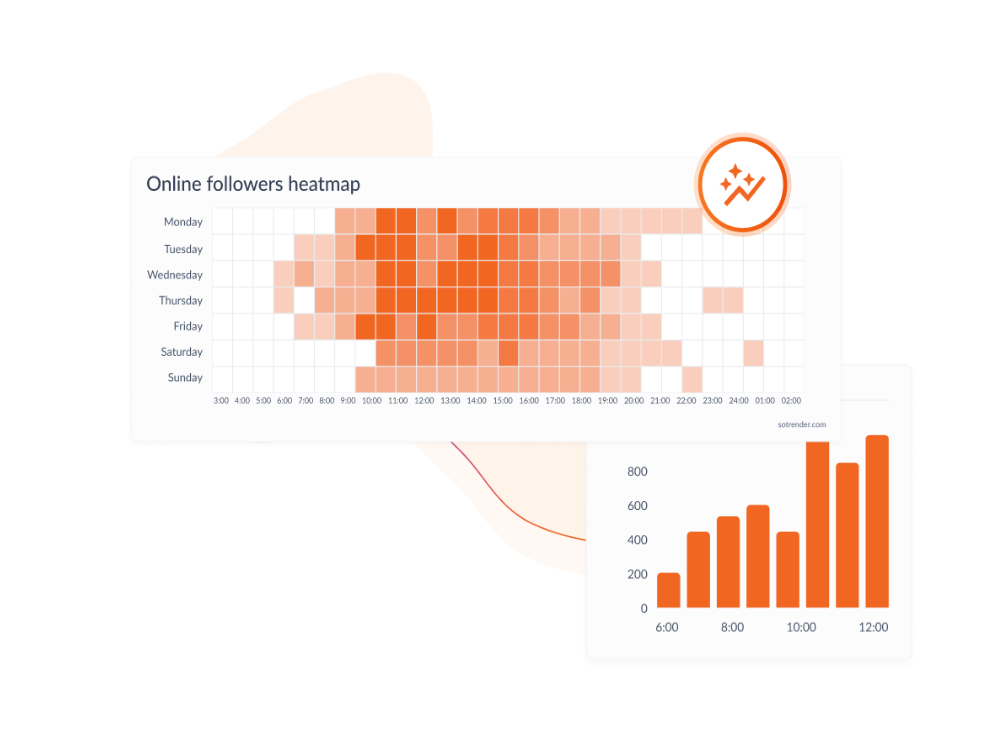
Use your analytics to find when your followers are active and when your best-performing videos usually go live. Check the best times to post on TikTok before blaming the caption, especially if your hashtag set looks relevant but early engagement stays weak.
TikTok hashtags for local content
Local businesses often underuse location hashtags. A café using only #foodtok competes with global food content. A better set might include city, neighborhood, and service-based tags.
For example:
- #krakowfood
- #krakowcafe
- #krakowrestaurants
- #wheretoeatkrakow
Local hashtags work best when the video gives people something they can act on: where to eat, what to visit, where to book, what to try, or what is happening this weekend.
Local accounts should also test language variations. In some markets, English tags work for tourists and expats. Local-language tags may work better for residents.
TikTok hashtags for ecommerce and TikTok Shop
Ecommerce hashtags should match the product, buyer intent, and use case. For ecommerce teams, this same logic should also connect with the way products are organized across product listing pages, because TikTok demand often reflects how people browse categories, compare options, and search for use cases.
A compact desk lamp could use #desksetup, #homeofficeideas, #studylamp, and #smallspacedecor. These tags are more useful than broad shopping tags because they describe why someone might care.
For TikTok Shop content, avoid stuffing every product category into the caption. If the video shows one product solving one problem, keep the hashtags close to that situation.
Seasonal ecommerce hashtags can help too. Gift guides, back-to-school videos, Black Friday content, and holiday product demos all benefit from timely tags. Just remember that seasonal hashtags expire quickly.
TikTok does not exist in isolation, so compare it with broader social media trends when planning campaigns across channels.
TikTok vs Instagram hashtags
TikTok hashtags and Instagram hashtags do not work in exactly the same way.
On Instagram, hashtags have long supported topic feeds and discovery. On TikTok, hashtags interact more visibly with video behavior, watch time, search language, and trend participation.
That means a hashtag copied from Instagram may not perform the same way on TikTok.
If your brand publishes across both platforms, compare performance instead of assuming the same tags work everywhere.
Hashtags should support broader social media best practices, especially around profile search, content clarity, and audience fit.
Common TikTok hashtag mistakes
The biggest mistake is using hashtags that describe the outcome you want instead of the content you made.
#viral describes the creator’s wish. #mealprepideas describes what the viewer gets.
Another mistake is copying competitor hashtags without checking content fit. A competitor may perform well because of creator trust, editing style, posting history, paid support, or topic timing. Their hashtags may not be the main reason the video worked.
Some brands also overuse branded hashtags too early. A branded tag has more value when people recognize it or when a campaign has enough content behind it.
Finally, many accounts never refresh their hashtag bank. TikTok language changes fast. Trends age, communities shift, and search behavior changes. Your hashtag system should evolve with your content.
Troubleshooting weak hashtag performance
When TikTok hashtags do not seem to work, the hashtag may not be the main issue. Start with the video signal.
If you manage several accounts, TikTok analytics tools can help you compare performance without relying on native dashboards alone.
A simple TikTok hashtag workflow
Before filming, write one sentence that defines the video’s promise. This keeps the idea focused and gives you the core search language.
After editing, choose:
- one broad topic tag
- one or two niche tags
- one intent-based tag
- one trend, format, or branded tag if it truly fits
Before posting, search each hashtag inside TikTok. Check whether the content under that tag resembles your video in topic, format, or audience.
After posting, review performance in batches. Do not change your entire system after one weak post. Look at 10 to 20 posts and identify patterns.
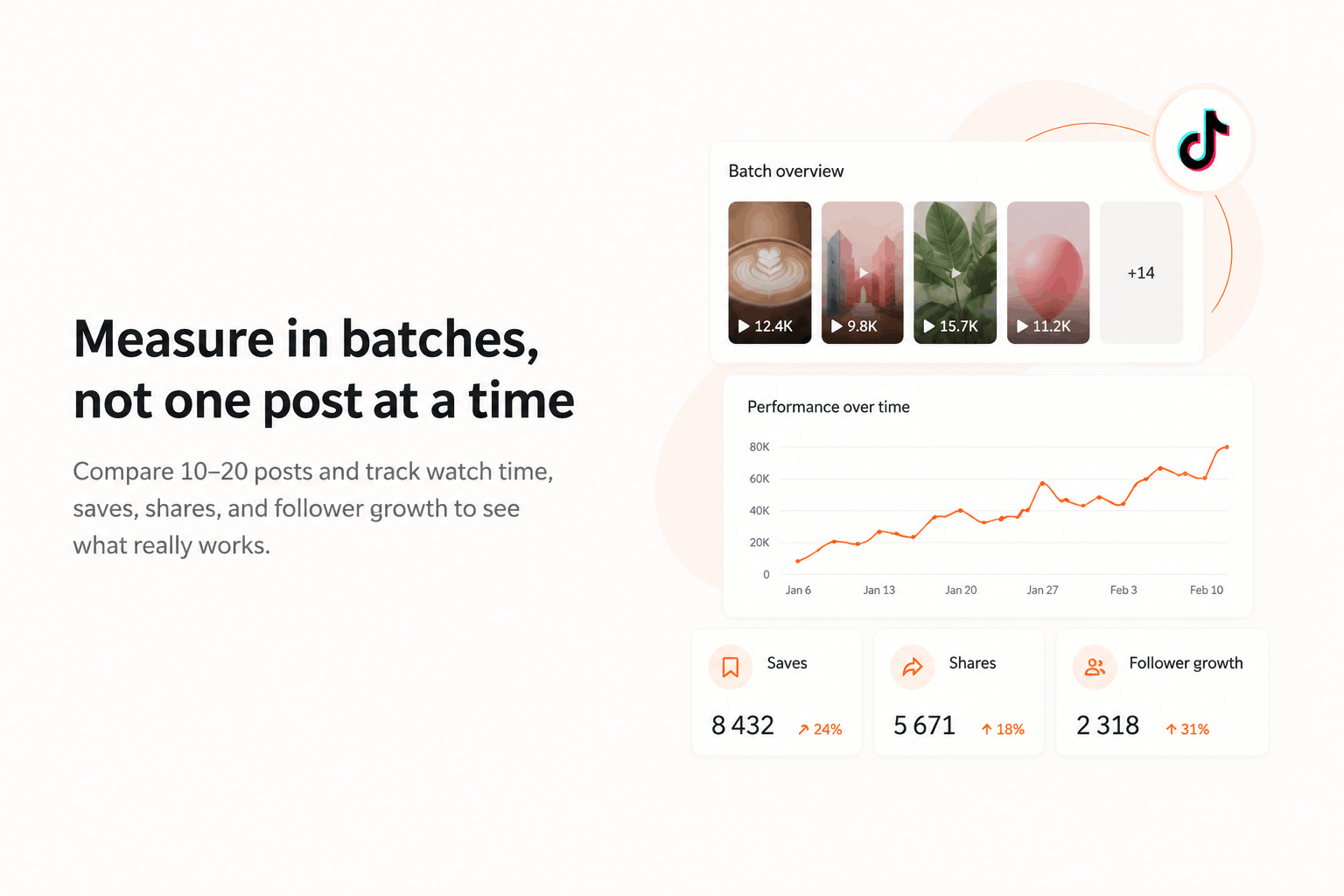
If niche hashtags consistently bring better saves and comments, lean into them. If broad tags bring views but no audience quality, reduce them. If trend tags work only for certain formats, keep them for those formats.
A practical TikTok hashtag template
Use this template when planning posts:
Most videos will not need every role. The template simply prevents random stuffing.
The final check is simple: would a real viewer understand why this hashtag belongs on the video? If not, remove it.
Key takeaways
- TikTok hashtags help classify your video, but they work best with clear captions, speech, and on-screen text.
- Three to five focused hashtags usually give a stronger signal than a long caption full of broad tags.
- Broad tags can support reach, but niche and intent-based tags often bring better audience quality.
- Trend hashtags need real content fit. Using a trend tag on an unrelated video can attract the wrong viewers.
- Branded hashtags work best for campaigns, content series, events, and user-generated content.
- TikTok SEO needs search-friendly language across the full video, not only in the hashtag set.
- Hashtag performance should be reviewed in batches, not post by post.
- Sotrender can help connect TikTok hashtags with actual performance metrics, so teams can stop guessing.
Conclusion
TikTok hashtags still matter, but not in the lazy “paste popular tags and hope” way. They work as part of a bigger relevance signal.
The better your hashtags match the video, audience, and search intent, the easier it becomes for TikTok to test your content with the right people.
Start with clarity. Choose tags that describe what the viewer gets, not what you want the algorithm to do. Then use analytics to see which hashtag groups bring real engagement, not just bigger numbers.
FAQ
Are TikTok hashtags still useful?
Yes, TikTok hashtags are still useful, but they are not a standalone growth tactic. They help TikTok categorize your video and connect it to relevant searches, trends, and viewer interests.
How many TikTok hashtags should I use?
For most videos, three to five focused hashtags are enough. Use fewer when the topic is extremely clear or when a post belongs to a branded campaign. Use more only when each tag adds a separate signal.
Should I use #fyp on every TikTok?
You can test it, but do not rely on it. #fyp is too broad to explain your content or audience. A focused hashtag like #tiktokstrategy or #runningtips usually gives TikTok more useful context.
Can hashtags make a TikTok go viral?
Hashtags can support discovery, but they will not turn a weak video into a viral one alone. Watch time, engagement, timing, topic relevance, and creative quality matter more.
Should brands use different hashtags than creators?
Usually, yes. Brands need more structure because they manage campaigns, reporting, products, approvals, and brand safety. Creators can test more loosely and react faster.
How often should I update my TikTok hashtags?
Review your hashtag sets every few weeks or after every 10 to 20 posts. Keep tags that attract the right audience, refresh trend tags often, and remove tags that bring random views without useful engagement.
Do TikTok hashtags help with search?
Yes, TikTok hashtags can support search visibility when they match the phrase or topic people look for. For best results, use search-friendly wording in the caption, on-screen text, and spoken content too.