


Competitive pressure is rising. More deals involve multiple vendors. More buyers compare pricing, positioning, and proof before they commit.
Yet many companies still rely on scattered competitor notes and surface-level analysis.
This creates blind spots. You lose deals without knowing why. You misread pricing gaps. And you chase visibility without understanding its impact.
Competitive benchmarking addresses these gaps by replacing scattered observations with structured comparison.
It measures your performance against rivals using real metrics.
When structured properly, benchmarking turns competitor comparisons into strategic decisions. Let’s take a closer look at how you can put competitive benchmarking into practice.
- 7 days for free
- No credit card required
- Access to all premium features during trial
What is competitive benchmarking, and why does it matter?
Competitive benchmarking is how you find out where you really stand against the companies trying to take your customers.
This comparison relies on measurable performance metrics such as:
- Revenue signals
- Share of voice
- Market share
- Win rates
It replaces instinct with evidence.
That matters more now than it did a few years ago. As Crayon’s 2025 State of Competitive Intelligence report shows, 55% of companies say more of their sales opportunities are competitive than in 2024. On average, companies estimate they lose 20 to 50 deals per year that they could have won.

This is because companies aren’t using competitive benchmarking to provide actionable intelligence. When they do, they get a clearer idea of how they compare to rivals and how they can better differentiate.
Effectively, by benchmarking, you can turn your comparisons with competitors into decisions.
Types of benchmarking and when to use each
Each type of competitive benchmarking answers a different strategic question.
- Performance benchmarking. Compares hard numbers like market share, web traffic, win rates, and brand key performance indicators (KPIs). Crayon’s 2025 report found 47% of businesses say the quality of analysis is the top factor in enabling sales. The better your analysis, the stronger your enablement.
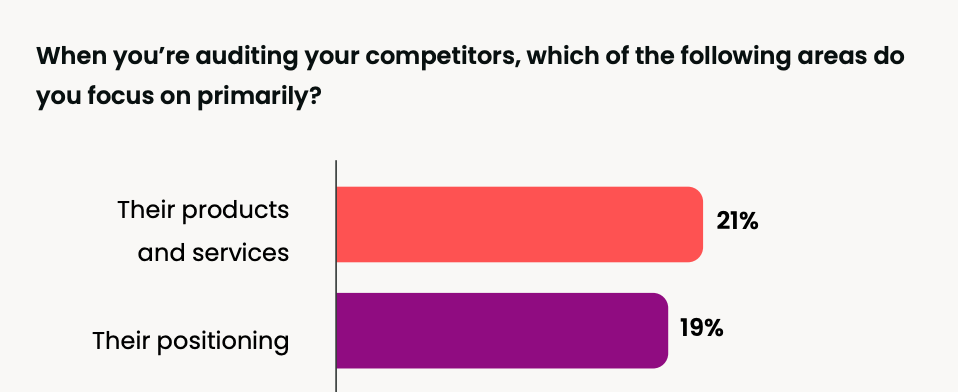
- Strategic benchmarking. Examines positioning, pricing, and business models. As the Competitive Intelligence Alliance’s 2024 report shows, CI professionals focus first on offerings and positioning. That’s because this is where differentiation lives.
- Process benchmarking looks at how work gets done. Think sales cycles, content velocity, social media management, and deal tracking. The goal is to expose and close workflow gaps.
How to build competitive benchmark reports that drive strategic decisions in five steps
A strong competitive benchmarking report begins with a clear business decision and builds the analysis around that outcome.
Why? When benchmarking connects to pricing, positioning, or sales strategy, it becomes a tool for progress. Leadership sees where to lean in. Sales understands where to focus. And marketing knows where to differentiate.
With the right structure, benchmarking shifts from observation to execution. It becomes a framework for confident decisions, not solely comparison.
Here are the steps to create valuable competitive benchmarks for better decision-making:
1. Define clear business objectives and benchmarking scope
Start with one business decision. Not ten. One.
A focused decision sharpens the entire competitive benchmarking process. It gives your analysis direction so that your metrics have purpose. This makes your outcome far more measurable.
To do that, choose the goal first, then select the KPIs that reflect real progress toward this goal.
For example, say you work in mortgage lending. Your goal might be pricing repositioning, market expansion, or revenue growth.
Here are the metrics you might measure for each:
➜ Pricing repositioning. Look at the current interest rate for a mortgage, APR spread, and fee structure.
➜ Market expansion. Review regional web traffic, local keyword rankings, and application starts by region.
➜ Revenue growth. Track market share, win rate by segment, pipeline conversion, and average loan value.
Make sure to set the scope tightly before you pull a single data point.
A benchmark across your entire portfolio will blur the signal. A benchmark focused on one product in one market for one audience will surface real patterns you can act on.
2. Identify competitors and map their business models
Map who you’re losing to.
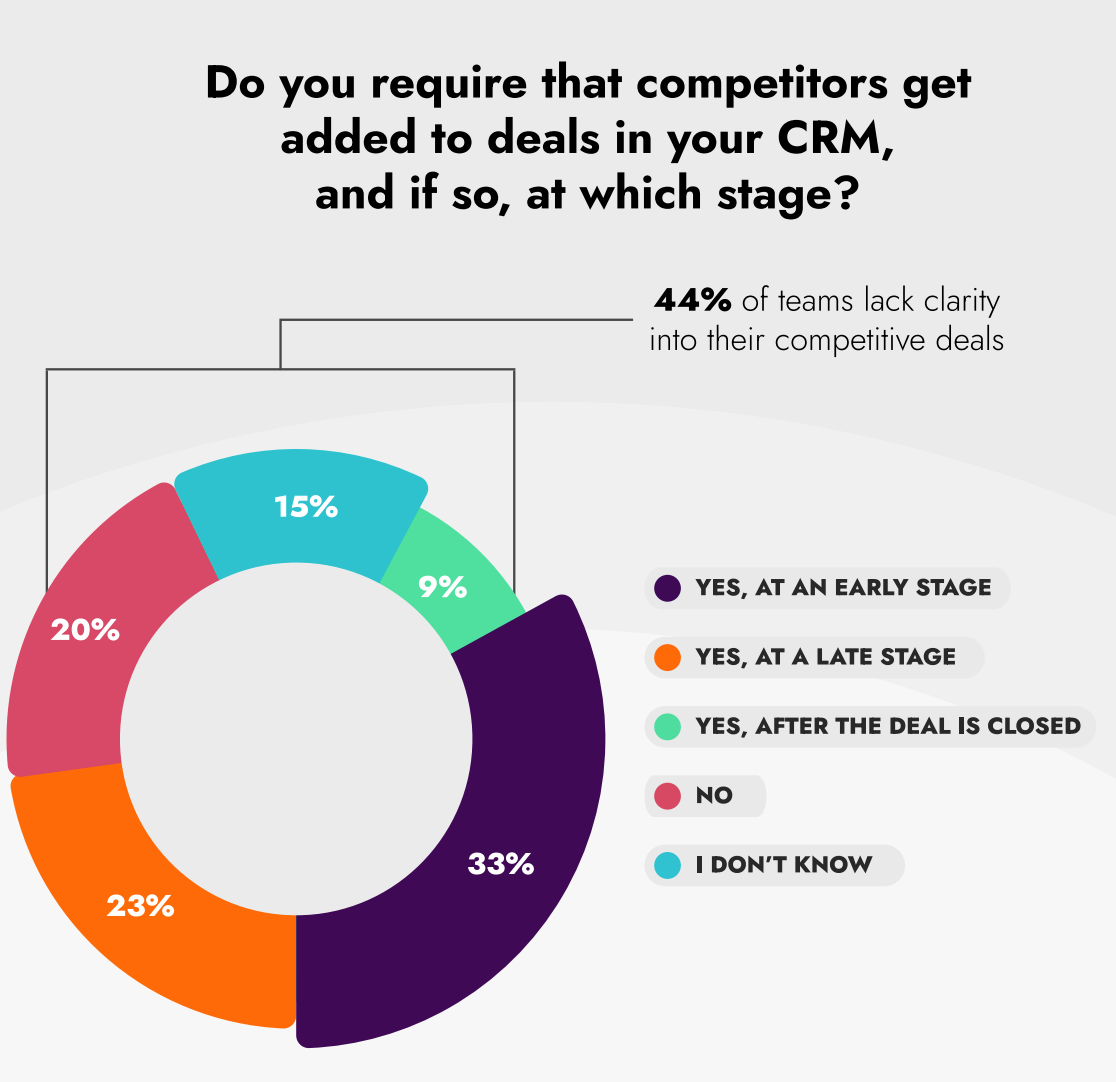
This may seem obvious, but many companies don’t. As Crayon’s 2025 report found, 44% of companies can’t see which competitors show up in deals in their CRM. But if you don’t know who’s in the room, you’re not benchmarking against reality.
Start with CRM deal data to identify direct competitors. Add indirect and aspirational players who shape market expectations.
Then go deeper.
Document pricing structures, positioning, distribution models, and core product features. Note geographic footprint and exposure across segments.
A benchmark built on the right comparison set shows you where you lead, where you fall behind, and what to do next.
3. Collect, standardize, and validate competitive data
Build one source of competitive truth by bringing all of your competitive data together.
That means one agreed set of definitions. One timeframe. One methodology.
Otherwise, different teams pull numbers from different tools using different assumptions. This is the fastest way for comparisons to fall apart. Instead, a shared source of truth keeps everyone aligned on what the numbers mean.
To build that centralized source of truth:
- Pull traffic and visibility data from tools like Google Analytics and Semrush.
- Use social listening platforms to measure share of voice and brand mentions.
- Standardize time periods, geography, and currency before comparing results.
- Document estimation methods so everyone knows what’s modeled and what’s measured.
Clear inputs create accurate benchmarks that all of your teams can stand behind.
4. Analyze performance gaps in the strategic context
Analyze the numbers to find out what they actually mean.
Dig beneath surface comparisons. (These shallow insights rarely drive strategy.) It’s the context behind those insights that helps you make decisions.
A pricing gap, for example, isn’t always an efficiency issue. It may reflect structural differences. For instance, for digital sellers, sales tax rules vary widely by state. That gap in tax obligations can affect margins, which explains why competitor prices vary across regions.
You’ll only make sense of this insight by examining the contextual data.
Strong analysis connects performance to its environment.
Here’s how to build that strength in practice:
- Overlay pricing data with cost structure signals.
- Factor in tax exposure, regulatory constraints, and market maturity.
- Incorporate sentiment trends and positioning shifts.
- Highlight where structural advantages, not tactics, explain performance differences.
When you add context, benchmarking stops being a scoreboard. It becomes a tool for strategy, especially for teams building and validating new ideas with the help of an MVP development company.
For example:
- You can see why a competitor’s price is lower. It might be tax rules. It might be the cost structure. Or it might be positioning.
- You can see if higher website traffic means strong customer intent or just more paid ads.
- You can tell whether growth comes from real demand or short-term discounts.
The point is to identify where structural advantages exist. Then you can decide whether to match them, counter them, or outmaneuver them.
5. Translate insights into strategic recommendations and executive-ready reports
Turn findings into clear ideas for action.
A benchmark report earns influence when it answers practical questions like:
- What do we change?
- Where do we invest?
- What do we stop?
Then, structure the output so decisions are obvious.
Build an insights dashboard that summarizes performance gaps. Then, map findings to a concrete action plan with defined owners and timelines.
Finish the report as a professional PDF for circulation. Tools like SmallPDF’s PDF editor can help. You can highlight key findings and combine your visuals into a single, clean report. Then, if you need to, you can remove any sensitive data before it goes to the board.
Share updates consistently to keep sales and leadership in step.
As Crayon’s 2025 report found, daily CI updates lead to an 84% increase in sales effectiveness.
This shows that regular insight keeps teams sharp. It arms reps with context before they walk into a deal and helps leadership see patterns early.
Wrap up
Competitive benchmarking works when it’s focused, contextual, and shared.
Remember:
- Define the decision.
- Align the metrics.
- Analyze the gaps.
- Turn insight into action.
But the real advantages come from building a repeatable system. This helps you track competitors consistently and surface shifts early.
Reliable analytics tools like Sotrender support that system. It centralizes data, monitors share of voice, and highlights performance changes. When benchmarking is ongoing, leaders get clarity and teams act with confidence. Start your free 7-day trial today.
FAQs on competitive benchmarking
How often should you update a competitive benchmark report?
Update it quarterly at the very least, and more often in fast-moving markets. Regular competitor research helps you track shifts in pricing strategies, positioning, and visibility.
Frequent updates also improve customer experience decisions. They help you respond quickly to changes in demand or sentiment.
What metrics matter most in competitive benchmarking?
The most useful metrics connect performance to growth. That often includes market share, win rates, customer satisfaction, and share of voice.
The right mix depends on your goal.
What are the best practices for making benchmarking actionable?
Follow clear best practices when benchmarking.
- Define one decision.
- Align metrics to that goal.
- Standardize your data and analyze the gaps.
- Translate insights into clear actions.