
LinkedIn works because your buyers are already there. As the world’s largest professional network, LinkedIn offers unparalleled reach and credibility for businesses. Actively managing and optimizing your LinkedIn presence—through profile enhancements, strong headlines, summaries, and visual branding—is essential for standing out and connecting with your target audience. They’re looking for solutions, comparing vendors, and reading up on industry trends. That professional context makes all the difference.
LinkedIn is the number one platform for B2B marketing, producing leads for 62% of B2B marketers. It delivers unmatched B2B marketing power through its professional user base and advanced targeting capabilities. Compared to Google AdWords, LinkedIn boasts a 28% lower cost per lead, making it a highly cost-effective lead generation platform for B2B marketers.
The platform keeps changing, too. New ad formats pop up every quarter, the feed algorithm gets tweaked, and suddenly your best-performing content from six months ago barely gets any traction.
Moerso, in 2026, LinkedIn is heading toward becoming an actual knowledge hub rather than just another social media network.
How do we know?
Their engineering team recently rewrote the feed algorithm. This means posts from people who actually know what they’re talking about will outrank generic motivational content further down.
So, if you want to show up on your audience’s radar and drive measurable results, you need to position your brand as an authority in the space and create targeted content.
We’ll discuss how to do that in this article.
Why is LinkedIn Important to Your Business Growth?
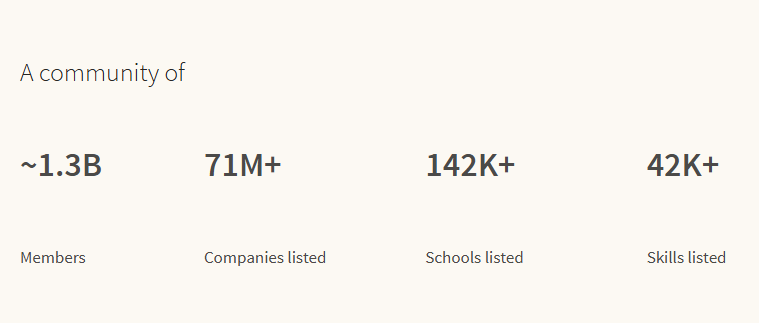
LinkedIn has become a massive hub for professional visibility, recently crossing the 1.3 billion member mark globally. Besides, over 71 million companies and 96% of Fortune 500 brands are active on the platform.
To maximize your LinkedIn marketing efforts, it’s crucial to create and actively maintain a dedicated LinkedIn account and an optimized LinkedIn company page. A well-managed LinkedIn company profile enhances your brand’s credibility, builds engagement, and expands your networking opportunities.
Positioning yourself there means an increased possibility of collaborations with other brands and quick access to business leaders you will not find casually, anywhere else. A well-optimized LinkedIn company page sets you up for LinkedIn marketing success and increases your credibility and visibility.
The professional atmosphere on LinkedIn also allows you to move through the sales cycle much faster than on other social networks. The platform connects users directly with decision-makers and industry leaders, enhancing networking opportunities.
While platforms like Instagram or X are often a chaotic war of stickers, memes, and recreational content, LinkedIn users log in with a high-intent, business-first mindset.
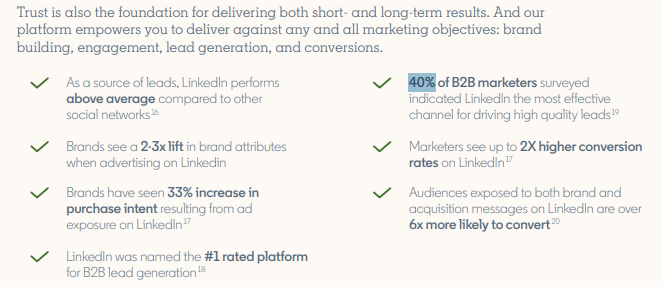
This shift in context is why over 40% of B2B marketers consider LinkedIn for quality leads.
But there’s more:
- LinkedIn outperforms other channels for high-quality leads by 277% in efficiency
- You can filter your outreach by job title, seniority, and specific company, reaching the 10 million C-level executives active on the platform
- The 2026 feed algorithm prioritizes knowledge-based content, meaning your genuine expertise earns more reach than generic engagement bait
- Using specialized analytics tools for LinkedIn, like Sotrender, allows you to move beyond basic likes. You can generate professional-grade reports in minutes, benchmark your performance against competitors, and use historical data to forecast future campaign success
- You can track long-term dynamics and sentiment, allowing your team to make everyday business decisions based on accurate ROI and reach metrics
- You can integrate the platform into an omnichannel support system for unified business communications
These benefits are essential to scaling your business.
How to Scale Your Business with a LinkedIn Marketing Strategy in 2026
The goal of marketing on LinkedIn is to build a network, generate quality leads, convert them into buyers, and turn buyers into loyal customers. Here’s how you can achieve that.
Know Your LinkedIn Audience
LinkedIn marketing is not a spray-and-pray strategy. You need to get specific with targeting and that starts with knowing who your audience is. Start by defining your LinkedIn target audience—identify the roles, industries, and company sizes that matter most to your business goals. You can do that by:
- Reviewing who already engages with your posts and what roles they hold
- Studying your past clients or customers and spotting common titles or industries
- Reading comments under posts from people you want to attract
- Checking LinkedIn search filters for job titles, company size, and seniority
- Noting the problems, your best conversations keep circling back to
Joining relevant LinkedIn groups is also a strategic way to engage with specific niches, participate in discussions, and establish authority within your industry.
If a majority of your LinkedIn audience fits within your preferred business audience, keep creating content that is valuable to them.
If your audience is instead biased towards filler audiences, it’s time to examine your LinkedIn content and profile to see why it’s attracting the wrong set.
Take YourDoctors, a telehealth platform for online consultations, as an example. The brand optimized its LinkedIn platform to highlight what it does and its goals. This ensures they connect with the right people.
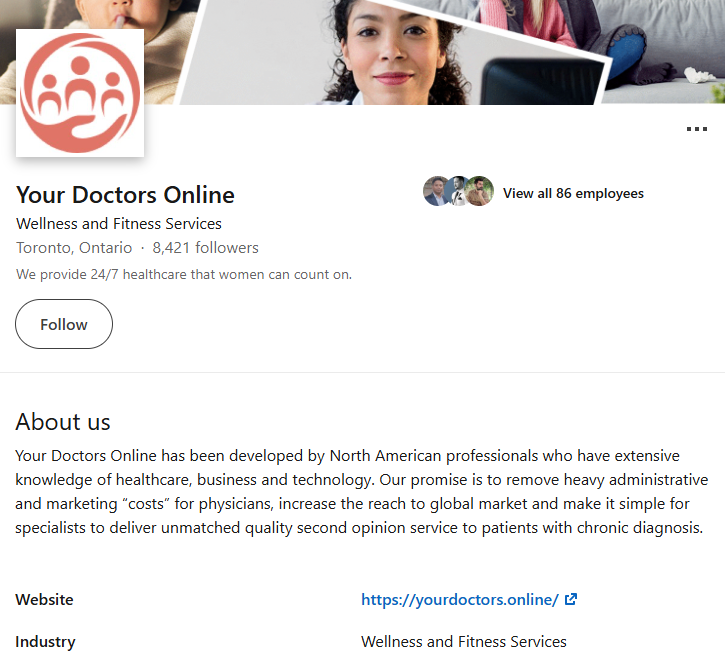
For better ad and content targeting, LinkedIn recommends focusing on industry position and expertise when creating content and your profile.
“Our AI systems and algorithms consider hundreds of other signals to determine what content appears in your Feed, including many signals from your own profile (such as your position or industry), network, and activity. A side-by-side snapshot of your own feed updates that are not perfectly representative, or equal in reach, doesn’t automatically imply unfair treatment or bias.”
Create content that zeroes in on marketing ops managers at 500-person SaaS companies in the Northeast. Or target data engineers at Fortune 500 retailers who’ve visited your website. The more you do, the more your preferred audiences appear in your feed.
Set Clear Marketing Goals
Before you start posting or launching ads, figure out what your goals and projected success look like.
- Maybe you need more people to recognize your brand name when RFP season rolls around
- Maybe your sales team needs better leads than yesterday
- Or maybe you want to position your CEO as the go-to voice on supply chain innovation
Each goal requires different tactics.
Defining clear campaign objectives and key performance indicators (KPIs) is essential to guide your LinkedIn marketing efforts and measure success. KPIs help you track progress toward business goals, such as brand awareness, website traffic, or lead generation.
Use the SMART approach for more clarity. SMART means Specific, Measurable, Achievable, Reliable, and Time-bound. For instance:
“Generate 150 qualified demo requests from mid-market HR leaders in North America over the next 90 days, hitting at least a 1.5% click-through rate on our sponsored content.”
Notice how that’s way more useful than “increase brand awareness.” You can actually measure it, report on it, and know whether you hit it or not.
Match your content to where buyers are in their journey
A good LinkedIn content strategy prioritizes buyers’ position in the journey map and focuses on reducing friction at each stage.
Organic content is the foundation of a successful LinkedIn strategy. Consistently sharing valuable, non-paid posts helps build brand awareness, establish authority, and generate leads. Supplement this with collaborative articles—contribute expert commentary to AI-generated pieces to facilitate professional engagement and networking.
- Early on, your target audience wants to understand the problem better. Give them data, frameworks, or quick explainer videos
- Once they’re comparing options, they need proof—case studies, detailed walkthroughs, and ROI calculators
- When they’re ready to buy, make it easy with demos, trials, or direct contact info
Educational content beats promotional content every time. For instance, let’s say you provide a language learning platform, and the majority of your audience shows interest in learning Latin. You can create a short series of Latin posts, maybe a learn-with-me type over 30 days. At the end of the series, you can invite readers to continue with a subscription on your platform.
That’s better than churning out ad after ad of a video demo every day.
Write posts that teach something specific. Record 60-second videos showing one feature or explaining one concept. Create downloadable guides that people actually want to save and reference later and are supported natively.
A number of LinkedIn users say posting daily is a necessity. But that’s not a verifiable truth. Worse still, you might get no result if you’re just recycling the same ideas.
Instead, focus on building a couple of thoughtful, valuable, current, implementable, and well-researched articles per week. Your audience wants insights they can actually use tomorrow morning. That beats seven forgettable updates.
Some formats that consistently perform:
- Monthly deep dives from your product team showing how they solved a specific technical challenge
- Quarterly benchmark reports or buyer’s guides distributed through Document Ads
- Weekly posts from leadership that take a clear stance on industry issues, backed by data
- Short video tutorials with captions, focusing on one actionable tip per video
Leverage LinkedIn Features and Tools
LinkedIn gives you plenty of ways to reach people:
- Sponsored Content and Document Ads work well for getting your message in front of new audiences
- Lead Gen Forms reduce friction since people don’t have to leave LinkedIn to sign up with native lead capture
- Conversation Ads and Message Ads land directly in your targets’ inboxes. Use these carefully with very targeted lists via native formats
- Thought Leader Ads amplify posts from your team members who have something interesting to say, announced by LinkedIn
- And LinkedIn Live works great for product launches, Q&As, or industry panels, supported directly
- Event ads are ideal for promoting live events, offering features like direct event links and regional targeting.
- Single image ads and native ads (such as Sponsored Content) are visually engaging formats that appear in the LinkedIn news feed and help you reach targeted audiences.
Use LinkedIn’s campaign manager to schedule posts, manage ads, and analyze results, streamlining your LinkedIn marketing activities and audience research.
Our core focus? Conversation Ads. They change how you generate leads. Instead of blasting everyone, pick specific job titles at specific company sizes and start real conversations. Such messages feel personal because they actually are personal.
On the organic side, pay attention to how the algorithm works. LinkedIn now prioritizes posts that share knowledge and get meaningful engagement, such as comments and saves.
- Post regularly and respond to comments within the first hour
- Encourage your team to share their own takes rather than just hitting the repost button
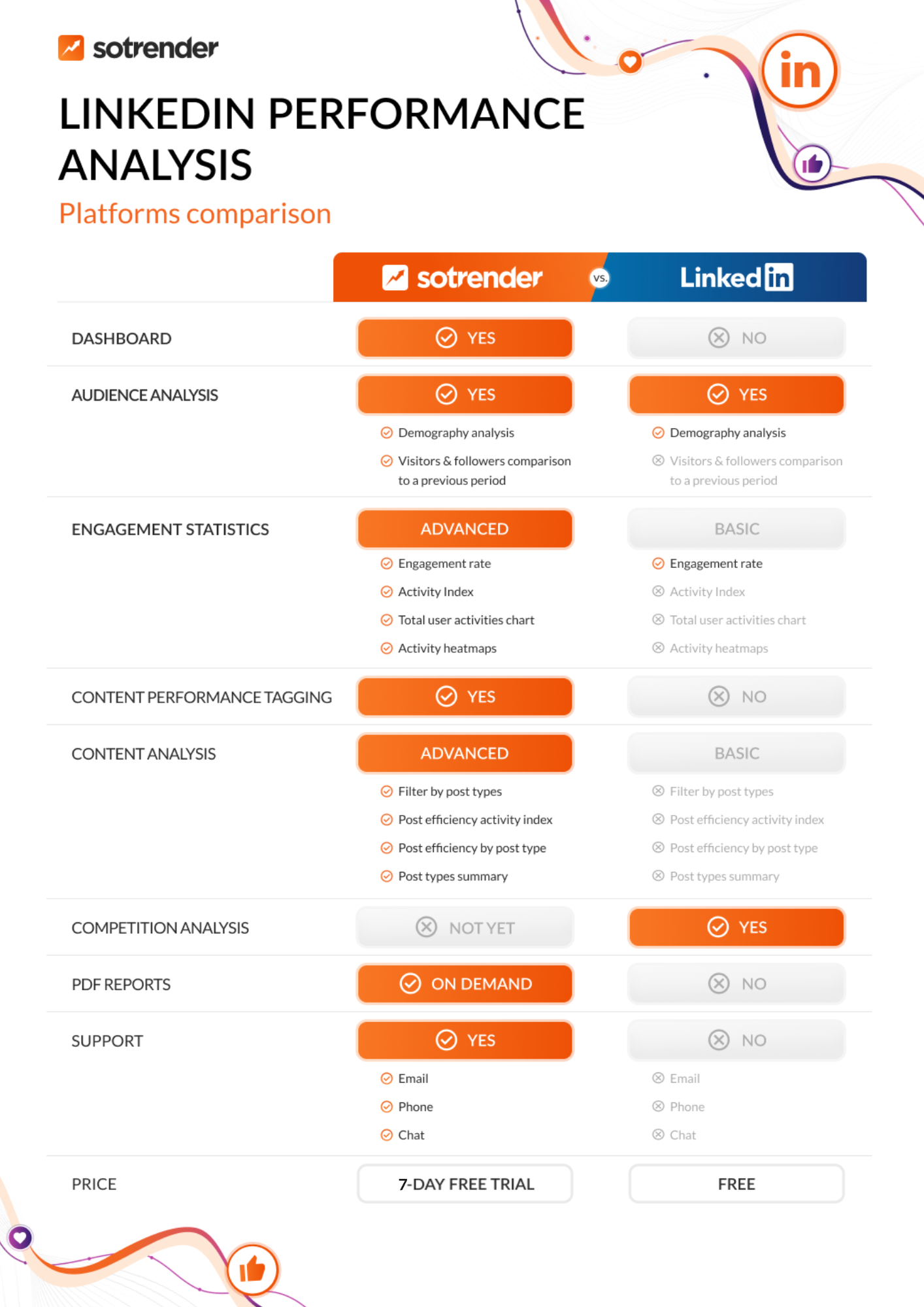
Track everything through LinkedIn Page Analytics with built-in reporting, but connect it to your CRM so you know which interactions actually turn into opportunities. If you want more detailed analytics, use Sotrender. Here’s a graphical representation of why Sotrender is a better option.
Build and Engage Your LinkedIn Network
Growing your network isn’t about hitting 500+ connections as fast as possible. Focus on quality.
- Connect with people in your industry who share similar challenges
- Join Groups where real discussions happen (not just link dumps)
- When you see a thoughtful post from a potential customer or partner, leave a substantive comment
Try not to send a connection request without figuring out ways you could help that person first.
Introduce them to someone, share a resource, or offer feedback on something they’re working on. This turns cold outreach into actual conversations.
Direct messages are a key channel for building personal connections and nurturing leads—make sure your outreach is thoughtful, clear, and personalized.
Networking on LinkedIn is a two-way street; engaging with other people’s posts is just as important as posting your own content. Give as much as you receive to nurture mutually beneficial relationships.
Your employees can amplify everything you do. But don’t just ask them to share company posts verbatim. Give them talking points and let them write in their own voice. Their networks trust them more than they trust your company page.
Employee advocacy is a critical element of LinkedIn marketing. Employee advocacy programs encourage and facilitate employees to share branded content, significantly amplifying your brand’s reach, enhancing personal and professional visibility, and supporting recruitment and trust-building efforts.
Building a personal brand for employees and executives complements your company’s LinkedIn presence, humanizes your business, and strengthens credibility.
Measure Success and Optimizing Campaigns
Track metrics that matter to your business:
- Which post types get the most engagement from your target audience
- How many people save your content for later
- Click-through rates and cost per lead for different ad formats
- Whether leads from LinkedIn actually convert to opportunities
- Which target accounts are viewing your profile and engaging with content
- How many people register for events and actually show up
Use LinkedIn’s native analytics to monitor content performance, follower growth, and audience engagement. Monitoring follower growth is important for tracking the effectiveness of your strategies and demonstrating long-term audience development.
Engagement rates tell you if content resonates, but you should care more about downstream metrics.
Are people from target companies viewing our profiles? Are they saving our content? Those behaviors predict future opportunities better than likes ever will.
Look for patterns in what works:
- Maybe Document Ads consistently outperform single images for your audience
- Maybe posts about pricing get way more saves than posts about features.
Once you spot these patterns, adjust your strategy. Refresh creative every few weeks to avoid ad fatigue. Test different formats with the same core message. Write headlines that sound like something you’d actually say in a meeting.
For account-based campaigns, connect LinkedIn data with Sales Navigator to see which accounts show buying signals.
Use AI OCR for bookkeeping to extract structured data from invoices, receipts, and financial records. Then compare your summary expenses on marketing to the results obtained. This will help you know if you’re getting value for the money spent.
Using third-party LinkedIn marketing tools can help you track and optimize your LinkedIn marketing efforts, providing deeper insights into how your content fits into your broader marketing funnel.
Additional notes for scaling your business on LinkedIn:
- LinkedIn marketing is the strategic use of LinkedIn’s professional platform to build brand awareness, generate B2B leads, and establish industry authority through organic content and professional networking.
- LinkedIn is uniquely positioned among social platforms for B2B marketing and professional relationship building, offering precision targeting and measurable ROI.
- LinkedIn is a leading platform for B2B lead generation—89% of B2B marketers use it to generate leads. Lead generation on LinkedIn is highly effective, especially when engaging multiple stakeholders and tailoring messaging for different departments.
- Account based marketing (ABM) is a powerful approach on LinkedIn, allowing you to use targeted outreach (such as InMail and personalized campaigns) to engage specific accounts as part of a broader marketing plan.
- LinkedIn advertising operates on an auction-based system with three primary pricing models; choosing the right ad format (Sponsored Content, Text Ads, etc.) depends on your campaign objectives.
- Creating a content calendar helps ensure regular posting and keeps your LinkedIn strategy organized.
- Use LinkedIn Sales Navigator for advanced targeting and lead generation.
- Use relevant hashtags and customize your LinkedIn public profile URL to improve visibility on LinkedIn and across search engines.
- Optimize your LinkedIn profile by adding a background photo, using industry-relevant keywords, and ensuring it passes the ‘what do they do and who do they help?’ test in under five seconds.
- Use LinkedIn’s Featured section to highlight top-performing posts and increase profile engagement.
- Regularly update your profile to maintain its relevance and effectiveness.
- A comprehensive LinkedIn strategy combines organic content, paid campaigns, and ongoing analytics for the best results.
- 7 days for free
- No credit card required
- Access to all premium features
Future Outlook and Strategies for 2026
LinkedIn keeps adding AI features, including testing AI assistants, and that trend will accelerate. We’ll probably see better content recommendations, smarter audience targeting, and more automated optimization options.
In time, this social-turned-professional-networking platform will get much better at learning what each user needs and serving exactly that. That means your audience will see a curated feed of exactly the insights and connections that help them hit their goals.
It is your job to prepare for these changes by creating diverse content libraries now.
In addition to that, do these:
- Build a library of evergreen content tagged by topic, industry, and buyer role
- Collect first-party data through Lead Gen Forms, webinars, and content downloads, then use Matched Audiences to reach similar profiles
- Get more people from your company posting regularly—executive voices will probably get even more reach as the algorithm favors expertise
- Test new formats and audiences constantly, since what works will keep shifting
Conclusion
LinkedIn is most effective when you focus on being helpful rather than promotional.
Start by understanding your audience and their pain points, clearly defining what you want to achieve, and creating content that your buyers actually need. Then, utilize the platform’s features to get it in front of them.
Then measure what happens after they engage. Whether they become customers or churn a while after initiating a communication with you.
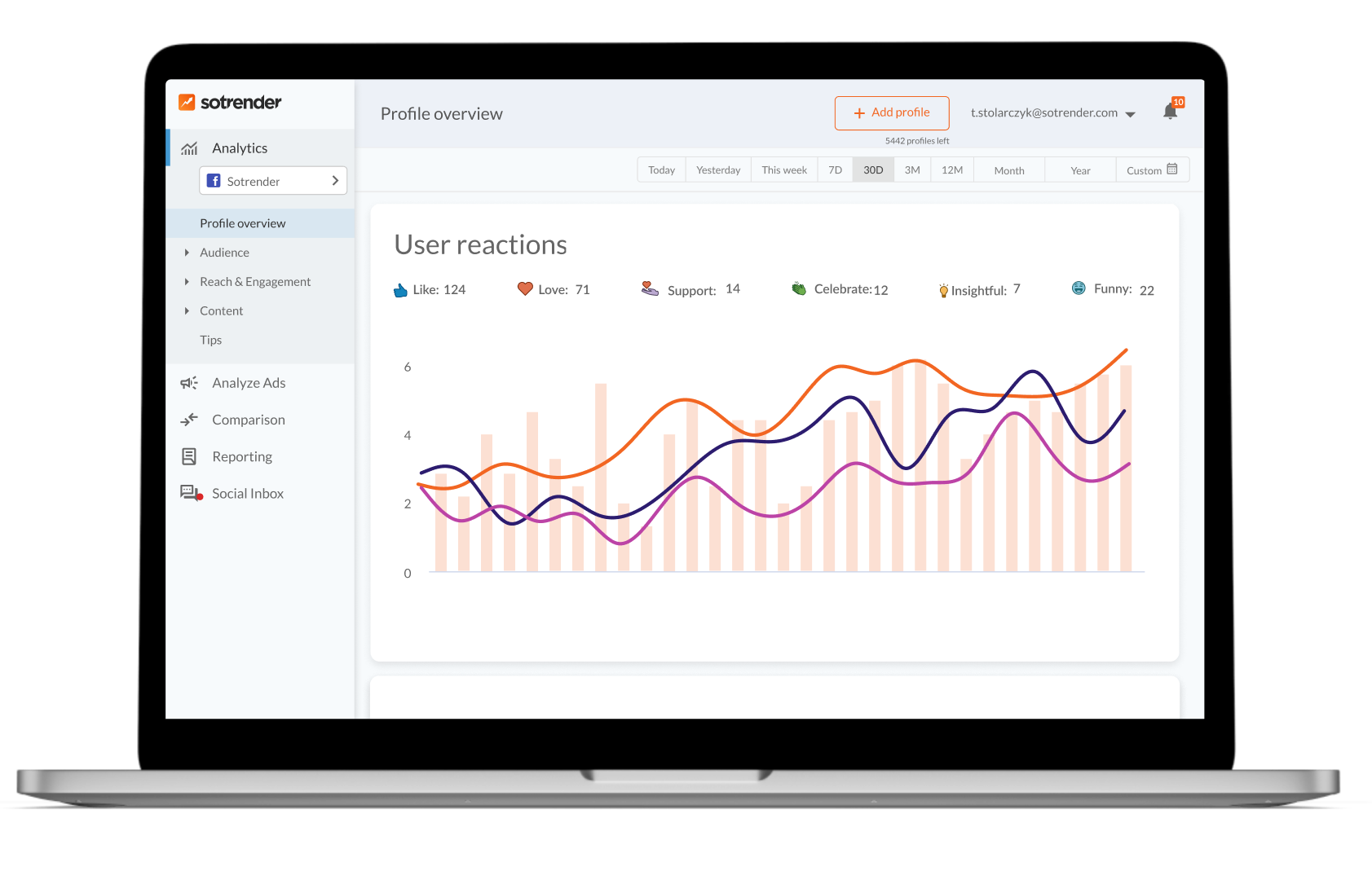
Data is the core of every successful marketing campaign. So, use Sotrender’s LinkedIn Analytics tool to analyze data and extract valuable insights to shape your marketing plans.